

Three Eras, Three Sensibilities
A pocket watch does not exist in isolation. It was carried alongside other objects, displayed in objects made for it, given as part of sets that expressed the taste and means of the person who owned it. Understanding the eras that shaped those objects, their materials, their aesthetics, their assumptions, makes the watches themselves more legible.
Victorian, abundance and dark wood
The Victorian period, broadly 1837 to 1901, produced objects at every price point in volumes the previous century would have found extraordinary. Industrialisation made decoration cheap, and the culture responded with an appetite for ornament that now reads as either exuberant or oppressive depending on your disposition toward density.
Watch stands from this period are among the most characterful objects in the company of pocket watches. The pocket watch stand, often called a watch holder, allowed the watch to serve as a bedside timepiece, resting at an angle where the dial could be read without lifting it from its resting place. Victorian examples were made in ebonised wood, walnut, mahogany, and papier-mâché inlaid with mother of pearl; in cast iron and gilt brass; in ceramic and painted porcelain. The more elaborate examples were architectural in their construction, miniature Gothic arches, turned columns, carved pedestals, expressing the period's fondness for historical reference and its considerable skill at producing it mechanically.
Wood is the dominant material of the Victorian watch stand in its humbler forms. Dark, solid, turned to a simple profile, with a curved rest at the front to support the bow of the watch, these are the pieces most commonly encountered, and they carry a quiet utility that sits well alongside the watches they were made to hold. A matched pair, a full hunter in a silver case resting in a walnut stand of the same decade, is a coherent expression of how these objects were understood and used.
Edwardian, restraint and white enamel
The Edwardian period (1901 to 1910, though the aesthetic extends meaningfully into the 1910s) represents a deliberate lightening after the Victorian appetite for accumulation. White and gold replaced dark wood and heavy ornament. The influence of French taste, particularly of the Louis XVI revival that had been circulating among the wealthy since the 1880s, found fuller expression in English decorative objects, and the result was a style of considered elegance that aged rather better than much of what came before it.
Watch stands and related pieces from this period tend toward slender proportions, painted or gilt surfaces, and restrained ornament. Silver objects, cigarette cases, dressing table pieces, card cases, were produced in large quantities for a market that valued the material and could afford it. The pocket watch of this period, often an open-face Swiss lever movement in a plain gold or silver case, sits naturally alongside Edwardian silver, both objects expressing the assumption that quality of material and simplicity of line were sufficient aesthetic statement.
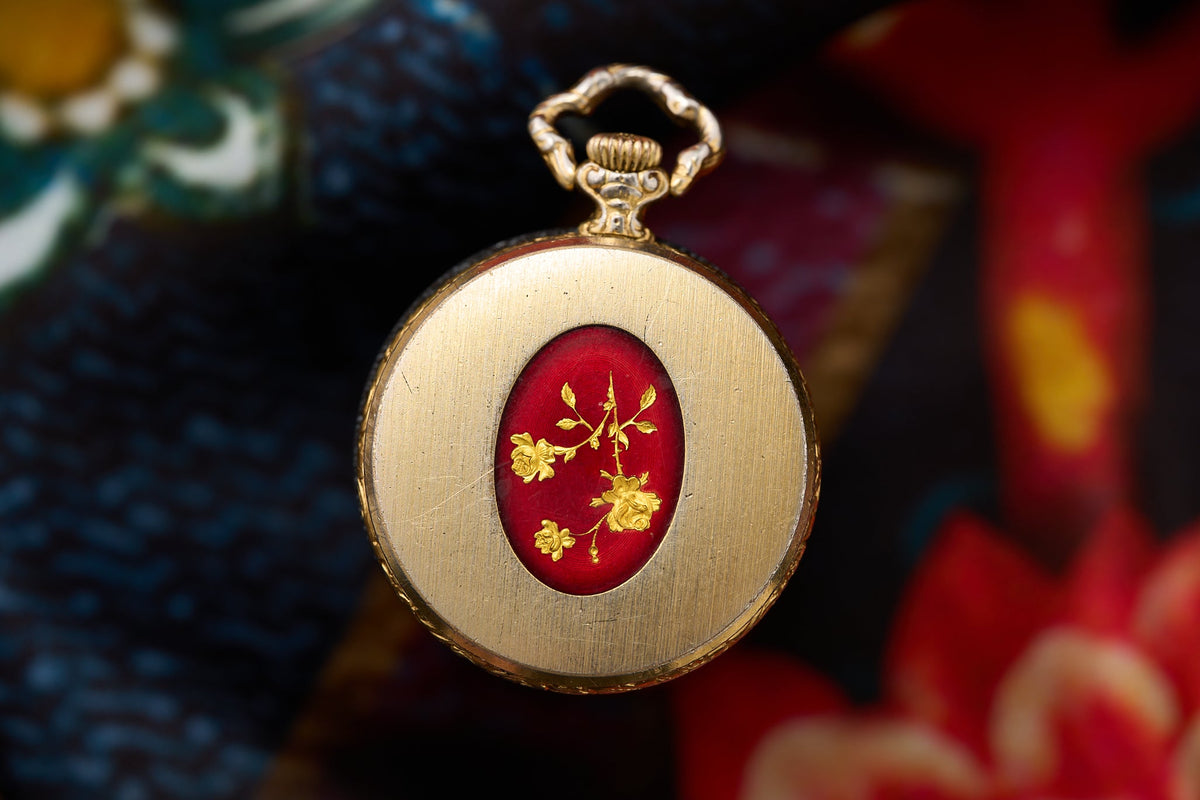
Ladies pendant watches of the Edwardian period are among the most refined objects at the overlap of jewellery and horology. Enamel cases, often in pastel tones with painted floral or figurative decoration, were set with rose diamonds and hung from delicate chatelaines or pinned directly to the dress. These are not primarily timekeeping instruments; they are statements of jewellery that happen to contain movements. The stand they rested on, when not worn, was as carefully considered as anything else in the dressing room.
Art Deco, geometry and lacquer
Art Deco, whose dominant period in decorative objects runs from roughly 1920 to the mid-1930s, rejected the curve in favour of the angle. Where Edwardian objects reach and taper, Deco objects are flat-faced, angular, and resolved. The materials changed: lacquer, chrome, bakelite, and sharply contrasting colours replaced the soft golds and painted enamels of the previous generation.
Watch stands of the Art Deco period, when they survive, are among the most immediately recognisable objects in a collection. A rectangular black lacquer stand with chrome fittings and a stepped profile could not be mistaken for any other period. The same is true of the watches made to sit in them, the thin rectangular cases, the stark numerals on cream dials, the absence of any decorative element that does not serve the geometry of the whole. A jump hour watch of the 1920s and a Deco watch stand of the same decade are expressions of the same visual intelligence, made at the same moment for the same sensibility.
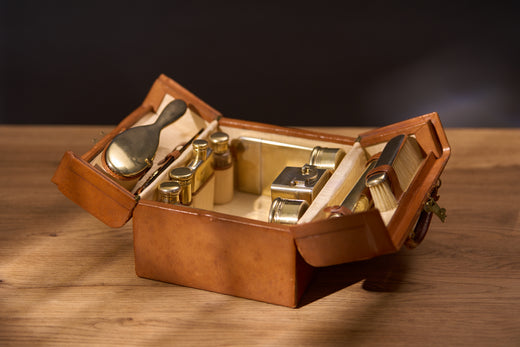
Boxes from this period, fitted watch boxes in leather and velvet, travelling cases with silk linings, were made to contain and present objects that deserved to arrive correctly. These are among the most satisfying secondary objects to find alongside a watch: a good Deco travel case, intact with its fittings, closes a circle between the watch and the world it moved through that no amount of description fully replaces.
Reading across eras
The pleasure of collecting across these three periods is the contrast they offer each other. A Victorian stand beside an Edwardian open-face beside a Deco jump hour is not merely a display of objects; it is a compressed account of how English and European taste moved through eighty years of cultural change. The pocket watch is the constant across all three; what surrounds it tells the rest of the story.