

I · The Maker/II · The Object/III · The Record/IV · Acquisition

Room I · The Maker
Ulysse Nardin, founded in Le Locle in 1846, built its name on marine and observatory precision timekeeping. By the 1930s the house was one of a small number of Swiss firms capable of submitting a split-seconds chronograph to the Neuchâtel Observatory trials: a complication requiring flawless column-wheel construction, fine-adjusted by a named régleur and tested over weeks under observatory conditions.
The complication · try it
Two hands, one axis
One centre hand stops to mark a split-second; the other keeps running. Press again and it flies back to catch up.
Ready
Press the crown to start.
Running handSplit hand
The Object
A documented 1937 Neuchatel Observatory competition watch: a sterling silver Ulysse Nardin split-seconds chronograph with a Guillaume balance, still running and splitting exactly as it should.
The most compact of the observatory pieces in this collection, and the one in silver: an open-face split-seconds chronograph of 54.7mm, entered by Ulysse Nardin in the 1937 pocket-chronometer trials at Neuchâtel. The certificate extract accompanies it and records an official rating of +1.52 seconds per day: a hand-made mechanism, carrying a second full complication, holding to within a second and a half a day under observatory examination.
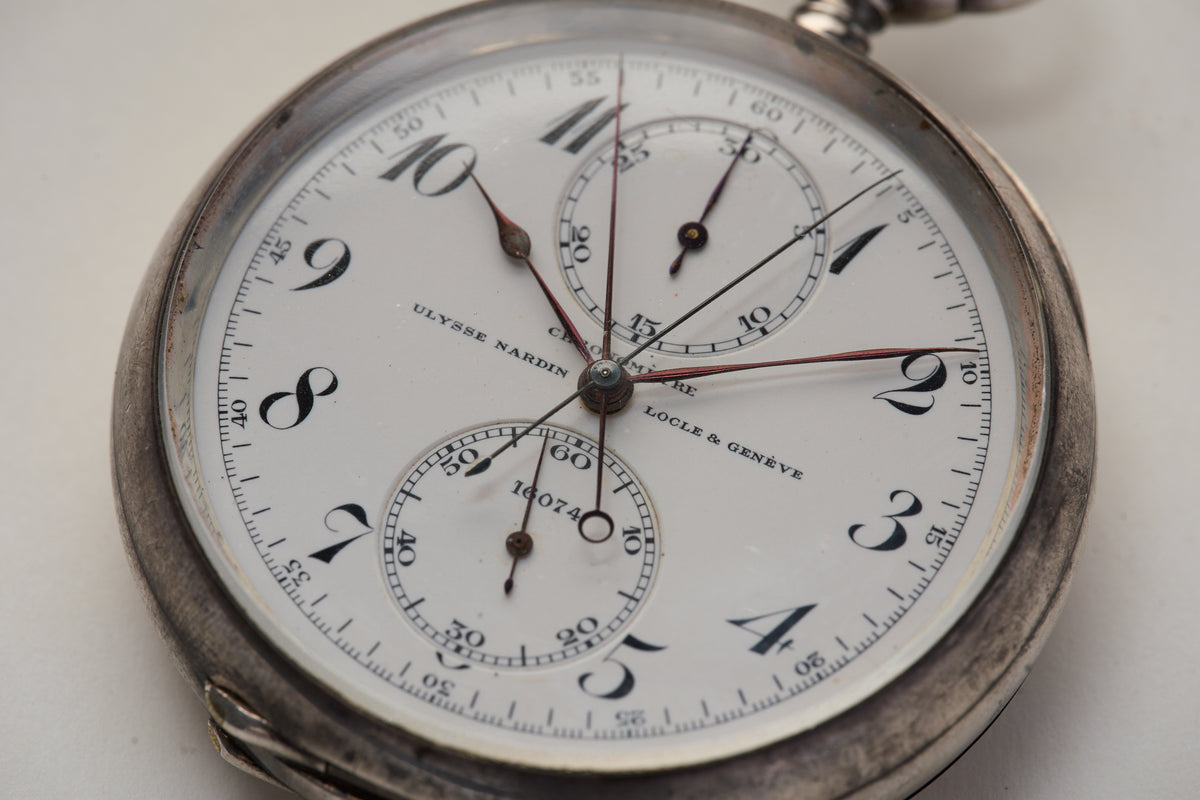
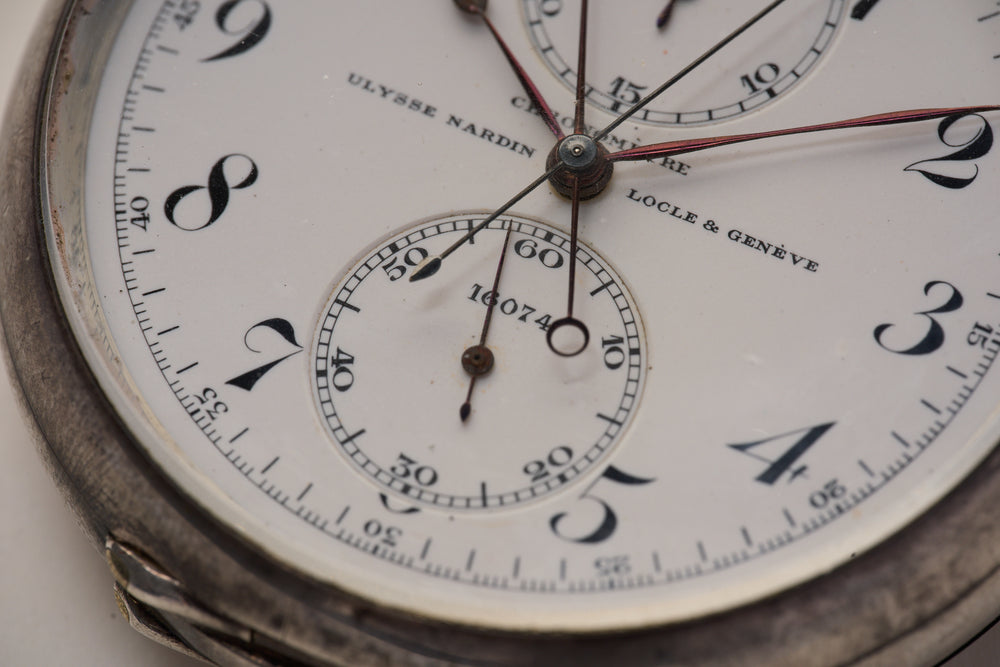
The dial is white enamel in excellent order, signed Ulysse Nardin, Locle & Genève and marked Chronomètre, with bold Breguet numerals, blued steel Breguet hands with the open ring near the tip, a thirty-minute register at twelve and constant seconds at six carrying the movement number. Two centre hands run together, one of them lacquered oxblood red; press the button and one stops to take a split while the other carries on, then flies back to rejoin it. Both the chronograph and the split work correctly, and the watch winds, sets and runs as it should.
The sterling silver case is Ulysse Nardin's own, numbered, and it wears its age openly: an even patina and the handling marks of nine decades, with nothing hidden and nothing polished away. The dial and the movement are the reason the watch exists, and both remain in the condition the trials demanded.
Of the four Neuchâtel chronometers in this collection, each has its own year, its own metal and its own result. This is 1937's, and the silver one.
The marks, the movement and the condition are set out piece by piece in the drawers below; the trial entry and rating are set out in The Record.
Beneath the case
Open each drawer to look closer
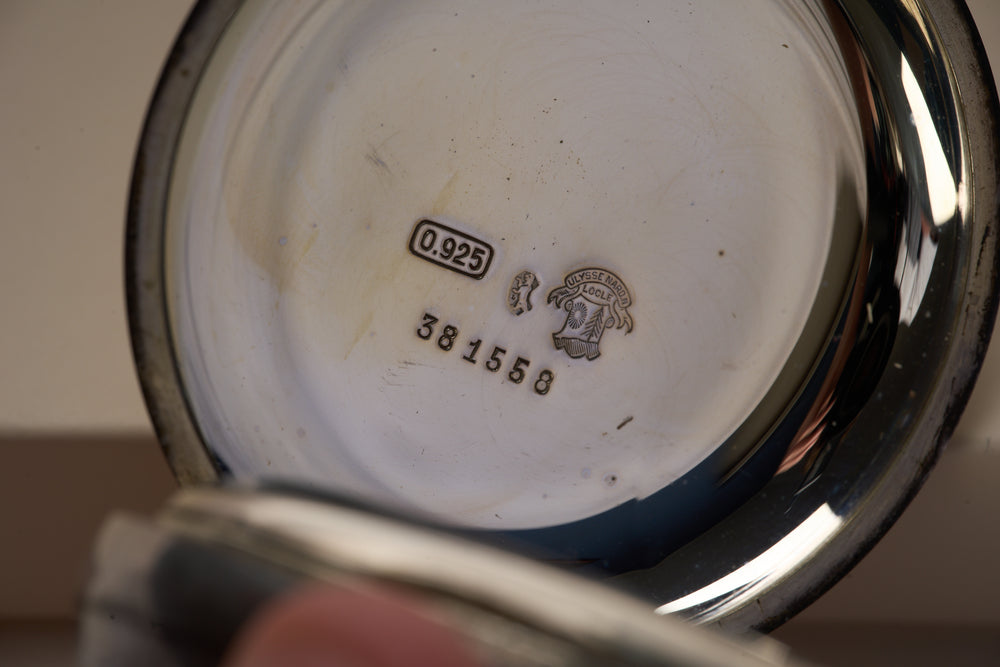
Mark 1
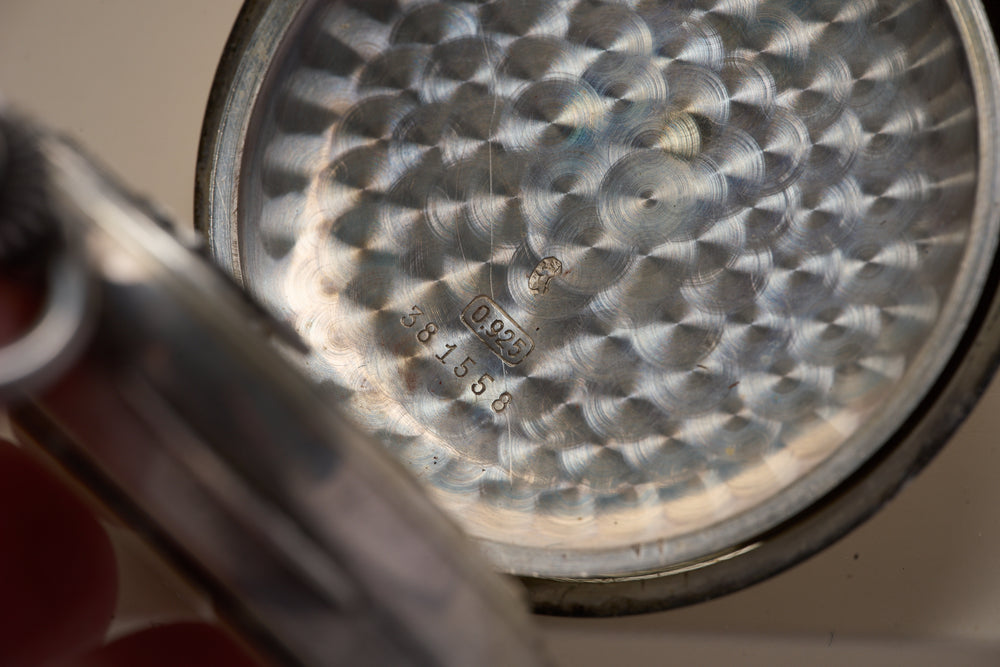
Case no. 381558
Struck on the interior of the case. Ties the silver shell to the movement serial in the factory record and confirms the case and movement were assembled as a matched pair for the 1937 competition submission.
case no.
factory struck
Mark 2
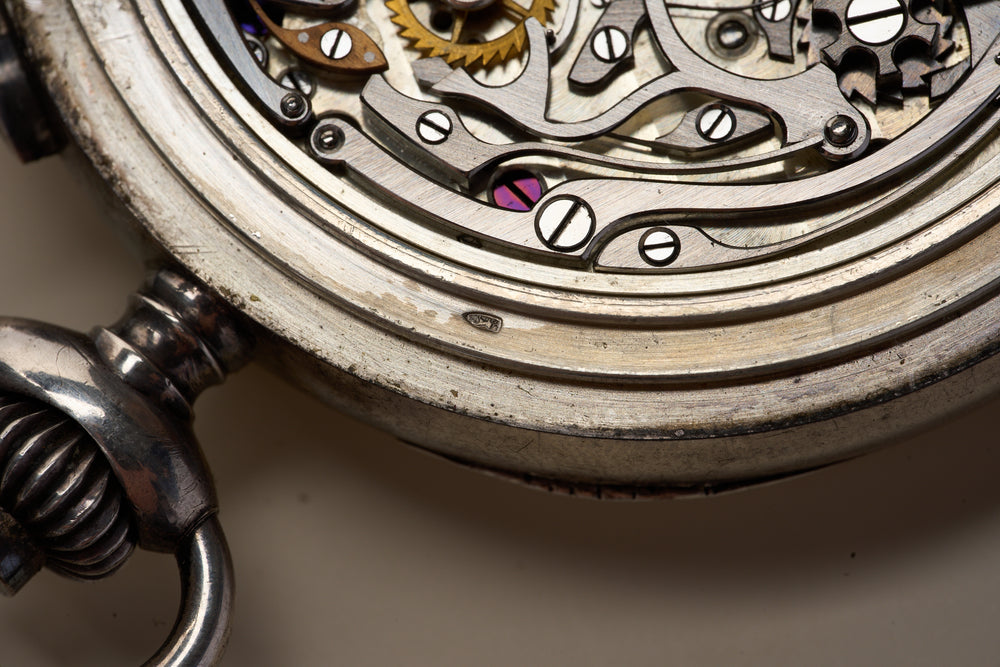
Swiss silver control mark (0.925)
The federal Helvetia-head stamp, applied by a cantonal assay office after the metal was tested. Sterling silver is 92.5% pure; the hallmark confirms it, independent of the case-maker's own declaration.
sterling silver 0.925
Swiss federal mark
Mark 3
Movement no. 16074 / secondary 54714
The primary serial appears on movement and dial; the secondary number links the movement to its production batch, a Ulysse Nardin convention that also appears in the régleur's submission record for Gerber.
serial 16074
matches extract
Mark 4
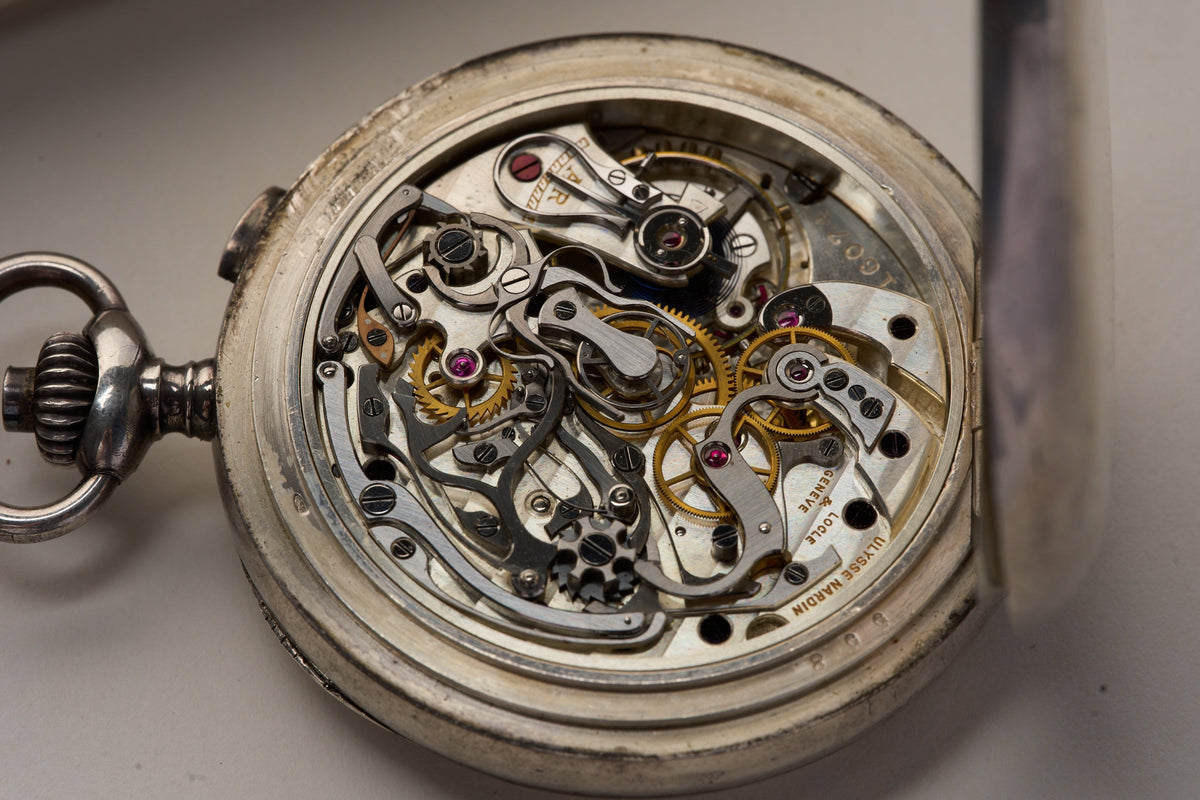
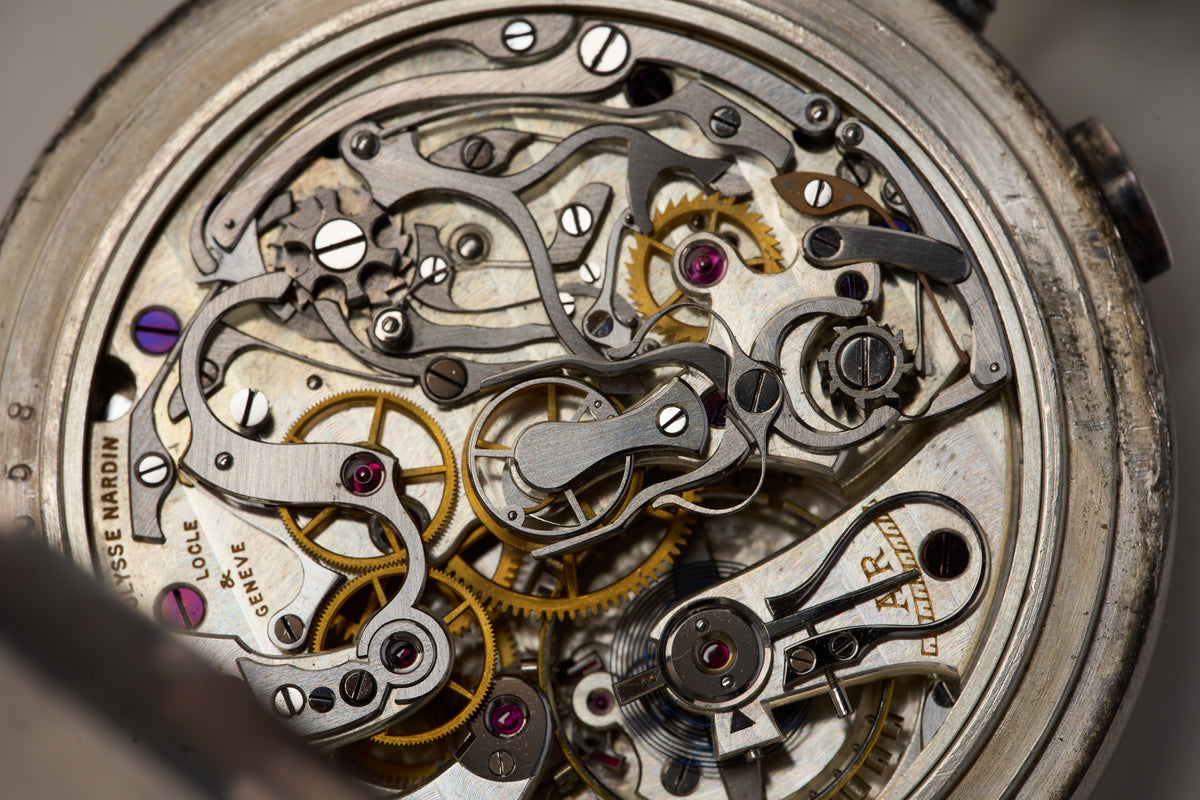
- AGuillaume integral balanceNickel-steel alloy engineered to eliminate middle-temperature error. Its presence here is not incidental: a Guillaume balance was specified precisely because the watch was built for the observatory, not the retail counter.
- BBlued Breguet overcoilThe terminal curve of the steel hairspring is raised over the body of the spring so it breathes concentrically. Bluing relieves internal stress. Paired with the Guillaume balance this is the competition horologist's preferred combination.
- CColumn wheelThe chronograph operates on a column wheel rather than the simpler cam mechanism, the correct specification for a split-seconds complication at observatory grade. Both the main hand and the rattrapante engage cleanly.
- DRéglage: Henri GerberFine-adjusted by Henri Gerber, whose name appears in the factory submission record. Setting a split-seconds chronograph for observatory precision requires weeks of multi-position adjustment; the régleur is as much a part of the provenance as the serial number.
Overall
Very Good, fully functional.
Case
Sterling silver, honest surface hairlines and patina throughout, no dents or splits. Three-part case; the snap back and inner dust cover both open and close correctly.
Dialone honest fault
White enamel, excellent
No cracks or chips; a few faint age specks near the centre and minor enamel wear at the 6 o'clock edge.
Movement
Clean and complete, running well. Column-wheel split-seconds chronograph, Guillaume balance, blued Breguet overcoil. Chronograph and split-seconds both function correctly. Winds, sets and runs correctly.
Crystal
High-domed, excellent, light surface marks only.
Crown
Silver crown and bow, honest wear, functions correctly.
54.73
This watch
25.75
€2 coin
A €2 coin is 25.75 mm. This case is more than two and a half times its area.
Room III · The Record

Supplied with the watch. Click to enlarge.
Neuchâtel 1937, competition entrant
Submitted to the Neuchâtel Observatory's Chronometres de Poche trials in 1937 and documented via the factory extract. The Neuchâtel competition tested movements daily across temperature, position and winding state; the result is not a certificate of sale but a record of regulated performance, timed against a reference of astronomical precision.
- Maker
- Ulysse Nardin, Le Locle & Geneve
- Model
- Split-seconds (rattrapante) observatory chronometer
- Movement
- Manual-wind column-wheel split-seconds chronograph; Guillaume balance; blued Breguet overcoil; lever escapement 1/5 sec; no. 16074
- Complications
- Split-seconds (rattrapante) chronograph, 30-minute register, constant seconds
- Case
- Sterling silver 0.925, open face, no. 381558
- Diameter
- 54.73mm
- Dial
- White enamel, signed, marked Chronometre, Breguet numerals, blued Breguet hands, oxblood split hand
- Country
- Switzerland
- Date
- 1937
- Provenance
- Documented entrant, 1937 Neuchatel Observatory chronometer competition; regleur Henri Gerber
- Serial
- Movement 16074 (secondary +54714)
The Estate Collection
Room IV · Acquisition
€13.000
We’d love to discuss our passion for this piece with you.


Ulysse Nardin
€13.000
Enquiry
Split-Seconds Chronometer, Neuchâtel 1937
×