

I · The Maker/II · The Object/III · The Record/IV · Acquisition

Room I · The Maker
Henri Gerber, named as régleur on both the 1933 and the 1937 Neuchâtel entries, was among the small circle of adjusters at Le Locle capable of bringing a split-seconds chronograph to First Prize standard. The 1933 First Prize was the highest distinction awarded to a pocket chronometer in Switzerland that year. Ulysse Nardin's sustained presence at the top of these results, across decades, is what distinguishes the house from its contemporaries.
The complication · try it
Two hands, one axis
One centre hand stops to mark a split-second; the other keeps running. Press again and it flies back to catch up.
Ready
Press the crown to start.
Running handSplit hand


The Object
A working split-seconds chronograph that competed at the Neuchatel Observatory and won a First Prize chronometer bulletin in 1933. Documented, and complete with its original box.
Of all the observatory watches in this collection, this is the one that won. In 1933 Ulysse Nardin entered movement 17731 in the pocket-chronometer trials at the Neuchâtel Observatory, where entries were rated for weeks, position by position and temperature by temperature, against astronomical time. It came away with the First Prize in the first class. The bulletin survives, the extract accompanies the watch, and the full result is set out in The Record below.
What makes the piece remarkable is that the precision lives inside a complication. This is a split-seconds chronograph: two centre hands sweep together, one stops at a press to catch an intermediate time, and snaps forward to rejoin its partner at the next. Regulating an ordinary watch to prize standard is hard; regulating one carrying rattrapante works is the summit of the craft, and everything here still functions exactly as it should.
The watch is built as an instrument. The case is polished steel in the full Goliath format, 65.9mm, with both covers closing firmly and the maker's cartouche inside. The dial is white grand feu enamel without a hairline or a chip: bold Breguet numerals under a blued steel poire hour hand, a thirty-minute recorder at twelve, small seconds at six carrying the movement number, and an outer track dividing each second into fifths, the scale the trials were read on.
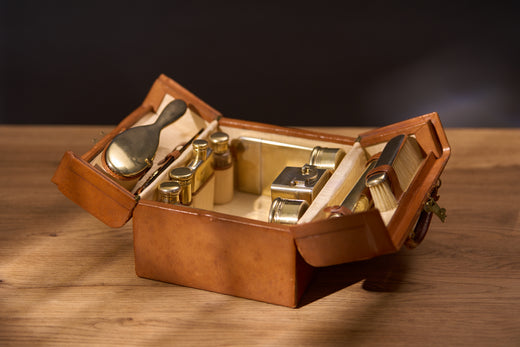
It winds, sets and runs correctly; the chronograph starts, stops and resets cleanly, and the split hand divides and catches exactly as designed. It is complete in its original Ulysse Nardin fitted box.
Ulysse Nardin sent watches to Neuchâtel for decades, and the house's standing rests on results like this one. Most surviving pieces of the type can claim the family resemblance; this one holds the prize itself.
The marks, the movement and the condition are set out piece by piece in the drawers below; the 1933 result and the observatory extract are set out in The Record.
Beneath the case
Open each drawer to look closer

Mark 1
Case no. 380110
Struck inside the caseback, cross-referenced to the observatory extract and the original box that accompanies the watch. The case number confirms this is the same shell that was submitted for the 1933 trials: the physical case that carried the First Prize result.
case no.
matches extract

Mark 2
Polished steel
Polished steel, a period convention for competition watches that prioritised dimensional stability over precious metal status. The polish is original, showing honest age consistent with a 90-year-old piece.
polished steel
competition case

Mark 3
Movement & dial 17731
The serial 17731 appears on movement plate, dial and in the Neuchâtel Observatory extract, the three-point match that establishes this movement as the First Prize winner and ties it unambiguously to the 1933 bulletin.
serial 17731
First Prize confirmed

- AGuillaume balance — 8 adjustments25 jewels, eight adjustments: the highest grade of precision finishing applied to a Swiss pocket movement of the period. The integral Guillaume balance was specified for observatory work; the eight adjustments are the régleur's signature, not the factory's.
- BSteel Breguet overcoilThe overcoil ensures the hairspring breathes concentrically under all positional conditions. A steel spring, rather than alloy, was Henri Gerber's preference; the bluing and terminal-curve geometry are part of his personal adjustment method.
- CColumn wheel, 1/5-second trackThe dial's outermost track divides the second into fifths, the finest standard division for a pocket chronograph. The column-wheel mechanism ensures snap-action engagement of both the main hand and the split-seconds rattrapante.
- DRéglage: Henri GerberThe same régleur who also adjusted the 1937 entry. Gerber's 1933 result, First Prize, represents the pinnacle of his craft: a mean daily rate of +1.15 seconds, recorded over the full competition period.
Overallone honest fault
Very Good
A well-preserved, fully functional example with honest age.
Case
Polished steel, 65.93mm open face. Honest wear to the plating; both covers close firmly. Some verdigris around the internal movement seat, not visible when displayed.
Dial
White grand feu enamel, excellent. No hairlines, chips or losses.
Movement
Clean and running well. Column-wheel chronograph and split-seconds both function correctly.
Crystal
Excellent, no cracks or chips.
Crown
Steel fluted crown; winds and sets smoothly (crown-pull setting). Runs, winds and sets correctly. Not bench-tested for rate; the 1933 observatory result recorded a mean daily rate of +1.15 seconds per day.
65.93
This watch
25.75
€2 coin
A €2 coin is 25.75 mm. This case is more than two and a half times its area.
Room III · The Record

Supplied with the watch. Click to enlarge.
1933 Neuchâtel, First Prize, 1re Classe
First Prize, Chronometres de Poche 1re Classe, Neuchâtel Observatory 1933. Mean daily rate +1.15 sec over the competition period, réglage by Henri Gerber of Le Locle. The First Prize was awarded to the single highest-rated movement in the class; this watch held that result. It is accompanied by the original observatory extract and the original box.
- Maker
- Ulysse Nardin, Locle & Geneve
- Model
- Split-seconds (rattrapante) chronograph pocket chronometer
- Serial
- 17731 (movement, matching dial); case 380110
- Year
- C.1933 (Neuchatel Observatory trial, 1933)
- Case
- Polished steel, open face
- Diameter
- 65.93mm
- Movement
- Manual wind, column-wheel split-seconds chronograph, lever escapement, 25 jewels, 8 adjustments, Guillaume balance, steel Breguet overcoil
- Dial
- White grand feu enamel, Breguet Arabic numerals, blued poire hands, 30-minute register, small seconds, 1/5-second track
- Complications
- Split-seconds chronograph, 30-minute counter, small seconds
- Country
- Switzerland
- Provenance
- First Prize, Chronometres de Poche 1re Classe, Neuchatel Observatory 1933; regleur Henri Gerber; original box and observatory extract
The Estate Collection
Room IV · Acquisition
€13.500
We’d love to discuss our passion for this piece with you.


Ulysse Nardin
€13.500
Enquiry
Split-Seconds First-Prize Chronometer, Neuchâtel 1933
×