

I · The Maker/II · The Object/III · The Record/IV · Acquisition

Room I · The Maker
Ulysse Nardin, founded in Le Locle in 1846, built its name on marine and observatory precision timekeeping and became a dominant force in the Neuchâtel chronometer competitions. A piece that combines a documented First-Class observatory result, a split-seconds complication and a Guillaume balance is an unusually complete example of what the house did best.
The complication · try it
Two hands, one axis
One centre hand stops to mark a split-second; the other keeps running. Press again and it flies back to catch up.
Ready
Press the crown to start.
Running handSplit hand
The Object
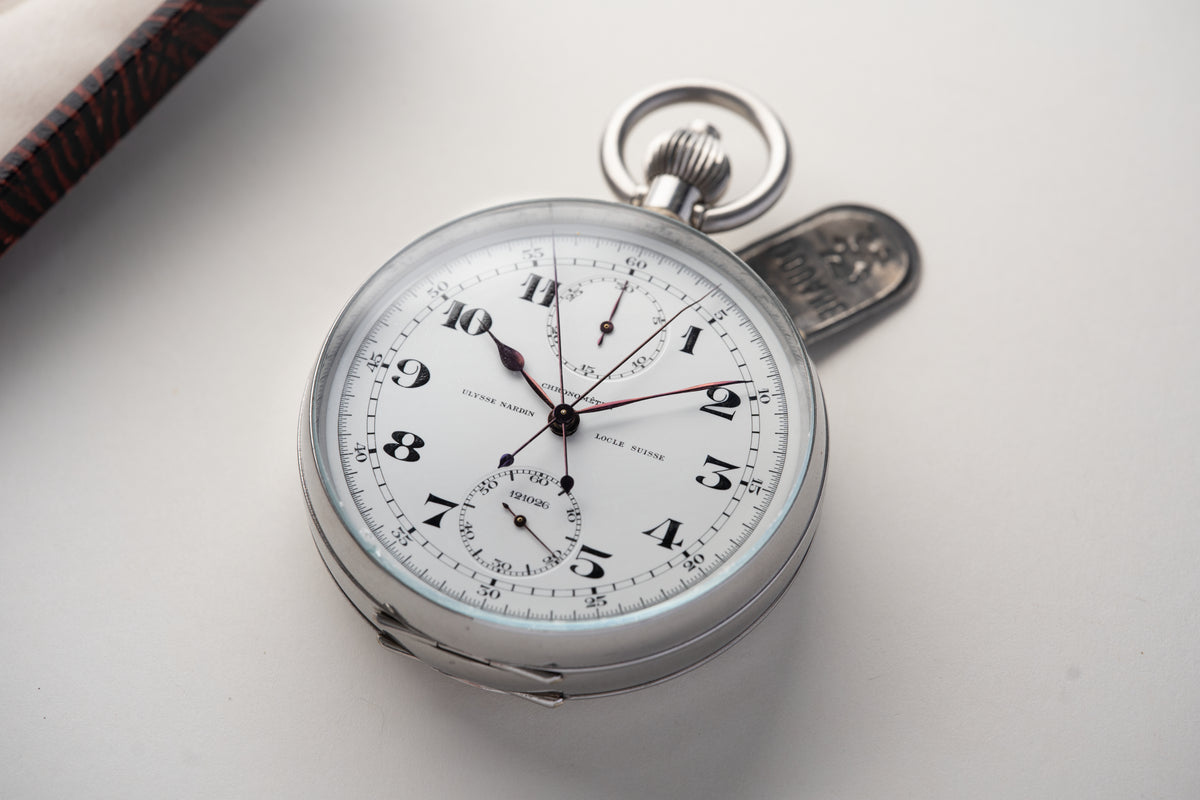
A documented First-Class observatory chronometer from the 1943 Neuchatel trials, cased as a split-seconds chronograph and complete with its original box and results extract.
One watch, doing two difficult things at once: keeping observatory-grade time, and driving a split-seconds chronograph while it does so. Ulysse Nardin entered this movement, number 121026, in the 1943 pocket-chronometer trials at Neuchâtel and placed in the first class; the printed extract accompanies the watch and the result is set out in The Record below.
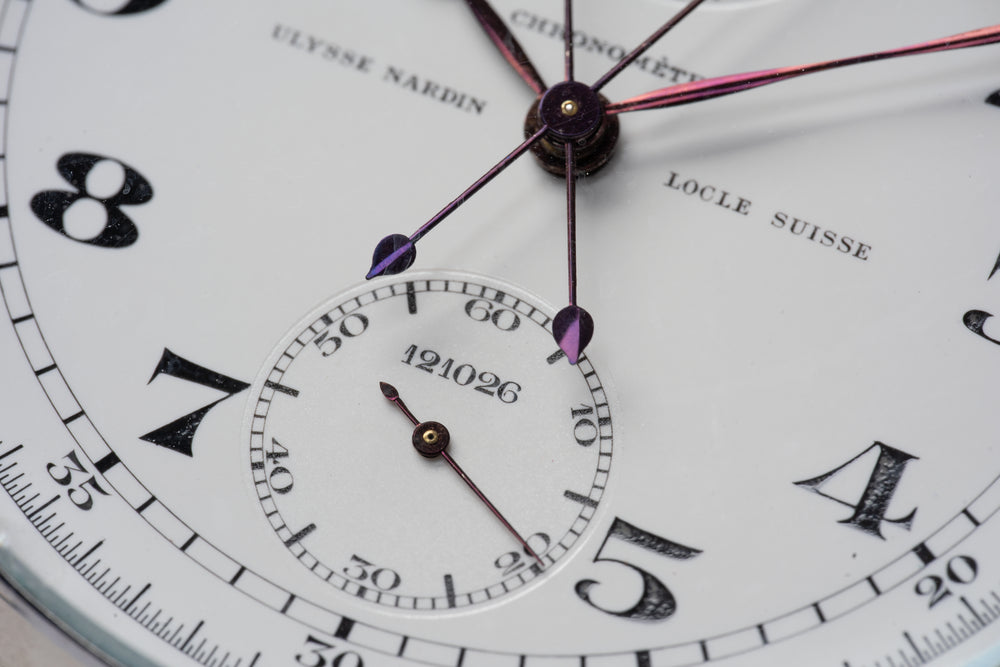
In the hand it is an instrument before it is anything else: a Goliath of 64.6mm in Staybrite stainless steel, hinged back, inner dust cover, a watch with the presence of a piece of laboratory equipment. The dial is white vitreous enamel, laid out for timing: bold Breguet numerals, violet-blued Breguet hands with the open ring near the tip, a thirty-minute counter at twelve, running seconds at six, an outer fifth-of-a-second track, signed Ulysse Nardin, Chronomètre, Locle Suisse and numbered to match the movement.
The split-seconds works from a large button on the case band: one centre hand stops to read an intermediate time while the other runs on, then the two snap back together. Start, stop and reset run through the crown pusher. Every function engages cleanly, and the watch winds, sets and runs well.
One honest fault, named up front: a small chip to the crystal rim near the seven. The crystal is a replaceable part, and the watch behind it is unaffected.
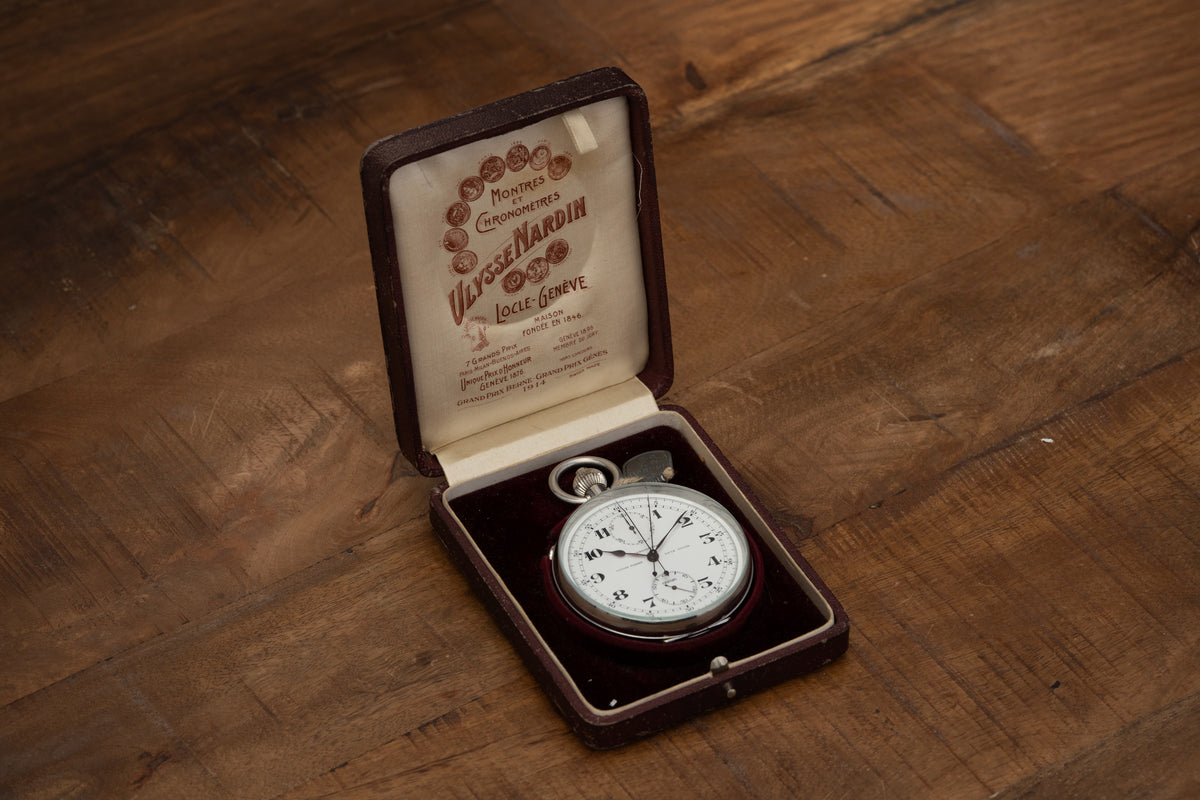
It is supplied in its original Ulysse Nardin Locle-Genève fitted box together with the observatory extract, a pairing that rarely survives intact. Watches of this class were made in small numbers for a purpose that no longer exists, and the ones that can still show their results are the ones that matter.
The marks, the movement and the condition are set out piece by piece in the drawers below; the 1943 placing is set out in The Record.
Beneath the case
Open each drawer to look closer
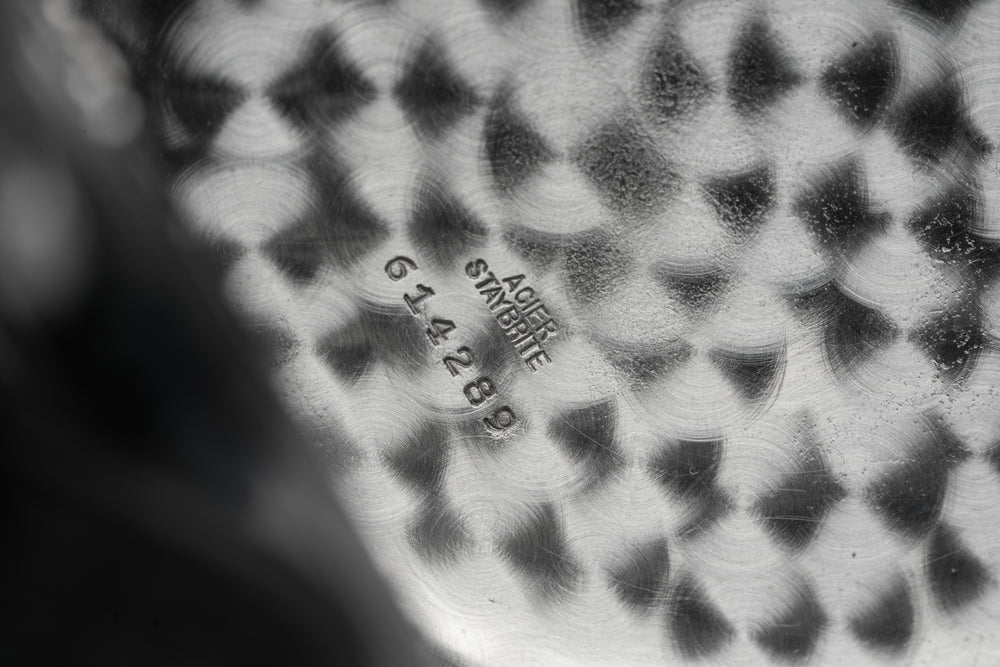
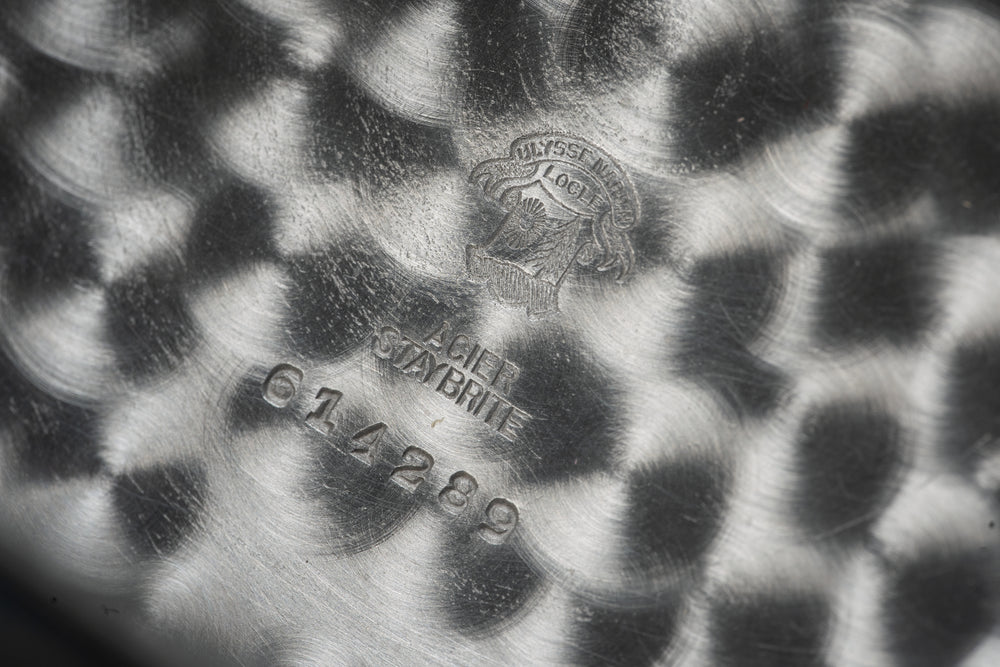
Mark 1
Case number 614289
Struck inside the caseback. It ties the case to the factory record and matches the numbering scheme Ulysse Nardin used for steel precision cases in the 1940s.
case no.
factory struck
Mark 2
Staybrite lozenge
The period mark for Firth's Staybrite stainless steel, the material precision watchmakers chose when they wanted a case that would not tarnish or distort. Not a hallmark in the assay sense: a maker's material stamp.
metal: Staybrite steel
c.1943
Mark 3
Movement & dial 121026
The same number appears on the movement and on the dial, the pairing the observatory database records, which is what lets us match this watch to the 1943 results rather than merely to the model.
serial 121026
matches extract
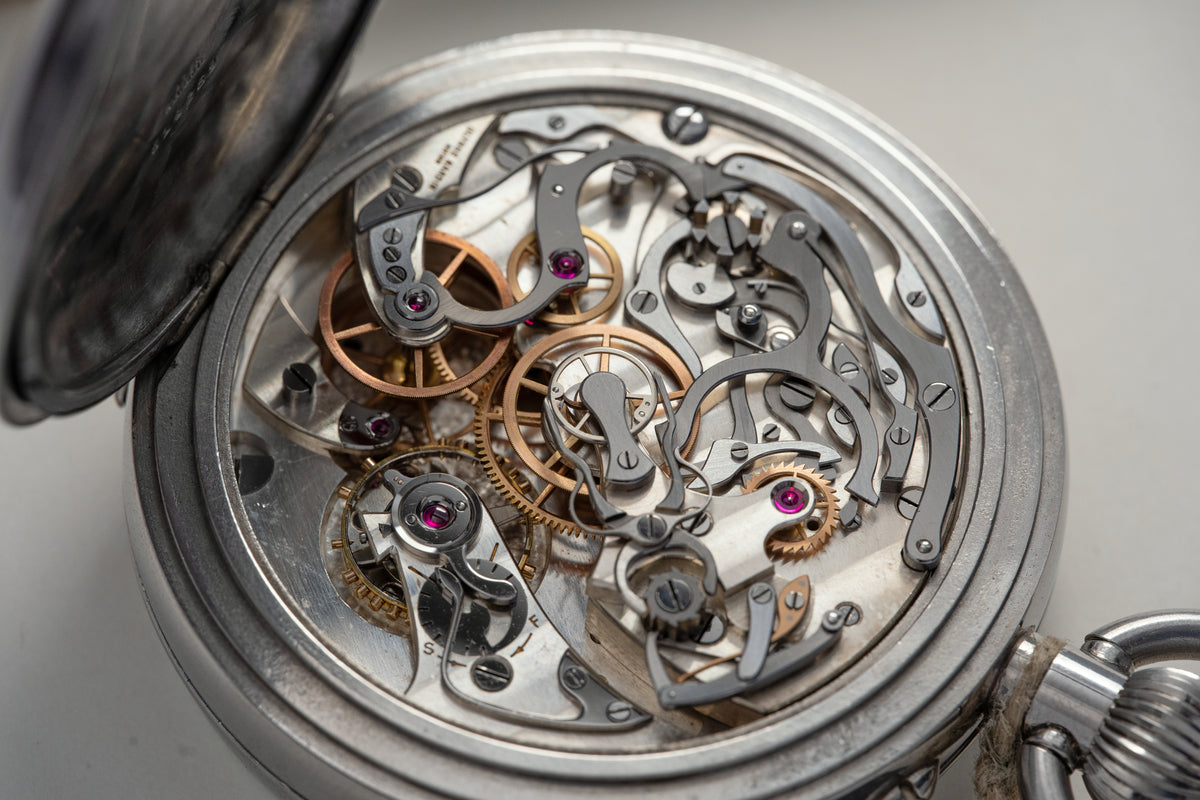
- AGuillaume integral balanceNickel-steel, designed to cancel middle-temperature error. Reserved for the finest precision movements, and the single clearest signal that this watch was built for the trials.
- BBreguet overcoil hairspringSteel, with the terminal curve raised over the body of the spring so it breathes concentrically. Paired here with a lever escapement timed to a tenth of a second.
- CColumn wheelThe chronograph is column-wheel, not cam, worked from the crown pusher, with a band button for the split-seconds. All functions engage cleanly.
- DRéglage: Édouard SeitzFine-adjusted by Seitz of Le Locle, one of the house's respected régleurs. The observatory record names him, and the movement carries his work.
Case
Excellent
Polished Staybrite stainless steel, crisp form with only light surface hairlines to the caseback from age. Hinged back and inner cuvette dust cover present and closing well.
Dial
Perfect
White vitreous enamel, no hairlines, chips or restoration; crisp signature, numerals and chronograph tracks.
Movement
Excellent
Clean and running well. Column-wheel chronograph and split-seconds both function cleanly. Guillaume integral balance, Breguet steel hairspring, reglage by Edouard Seitz.
Crystalone honest fault
Very good
One small chip to the crystal rim near the 7, a replaceable part; otherwise clear and sound.
Crown and pushers
Crisp
Crown pusher, split-seconds button and setting button all act cleanly. Winds, sets and runs well.
64.58
This watch
25.75
€2 coin
A €2 coin is 25.75 mm. This case is more than two and a half times its area.
Room III · The Record

Supplied with the watch. Click to enlarge.
1943 trials, 18th of 66
Chronomètres de Poche, 1re Classe. Score N=7.3, réglage by Édouard Seitz, Le Locle. Most watches described as observatory chronometers cannot show participation, let alone a placing. This one can.
- Maker
- Ulysse Nardin, Le Locle
- Model
- Split-seconds observatory chronometer (rattrapante)
- Year
- C.1943 (Neuchatel Observatory competition)
- Case
- Staybrite stainless steel, open face
- Diameter
- 64.58mm
- Movement
- Manual-wind keyless lever; column-wheel split-seconds (rattrapante) chronograph; ancre 1/10-sec escapement; Guillaume integral balance; Breguet steel hairspring
- Dial
- White vitreous enamel; Breguet Arabic numerals; violet-blued Breguet hands; 30-minute counter at 12; running sub-seconds at 6; 1/5-second outer track
- Complications
- Split-seconds (rattrapante) chronograph; 30-minute counter; sub-seconds
- Serial
- 121026 (movement and dial); case no. 614289
- Country
- Switzerland
- Accompanied by
- Original Ulysse Nardin Locle-Geneve box and Neuchatel Observatory database extract
The Estate Collection
Room IV · Acquisition
Price on Request
We’d love to discuss our passion for this piece with you.


Ulysse Nardin
Price on Request
Enquiry
Split-Seconds Observatory Chronometer, Neuchâtel 1943
×