

I · The Maker/II · The Object/III · The Record/IV · Acquisition

Room I · The Maker
Stainless steel was an exceptional case material for a competition pocket watch in 1953: the vast majority of Neuchâtel entrants arrived in silver or nickel. Ulysse Nardin chose steel here for its dimensional stability and resistance to magnetism, qualities that matter in a movement adjusted to a tenth of a second. The result is one of the rarer Goliath-format examples from the house's competition era.
The complication · try it
Two hands, one axis
One centre hand stops to mark a split-second; the other keeps running. Press again and it flies back to catch up.
Ready
Press the crown to start.
Running handSplit hand

The Object
A documented Neuchâtel Observatory split-seconds chronometer by Ulysse Nardin, cased in rare stainless steel. One of the hardest complications in watchmaking, offered with a factory extract that names its first owner.
The best documented of the observatory pieces in this collection. A split-seconds chronograph of 65.2mm in stainless steel, entered by Ulysse Nardin in the 1953 pocket-chronometer trials at Neuchâtel, and traceable from the competition bench to its first owner: the factory extract records that on 20 April 1954 the watch was delivered to Rodolfo Oscar Linke, a dealer in Genoa, one of only five of this calibre supplied to him. Few vintage watches of any kind carry paperwork that specific.
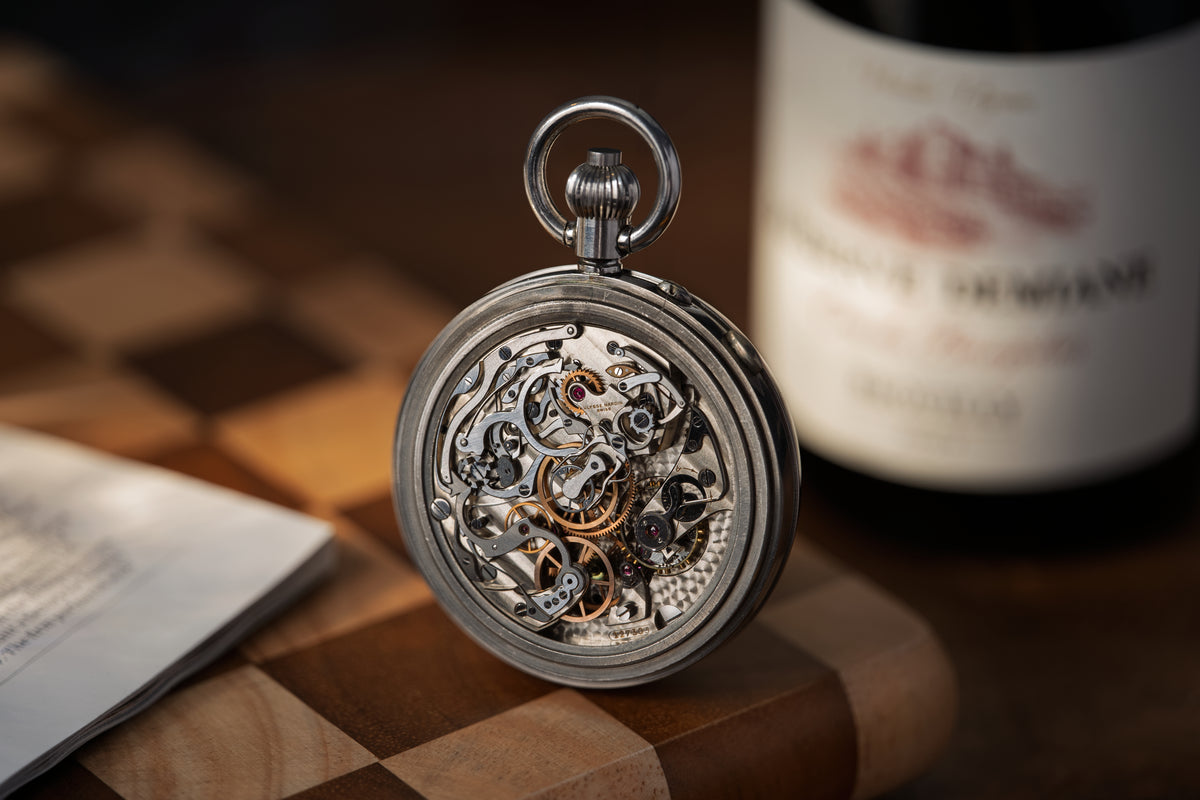
The movement is the spectacle. Ulysse Nardin's 24-ligne split-seconds calibre fills the case almost to its edge, and it is finished to be looked at: skeletonised steel bridges in black polish, gilt wheels, gold jewel settings, the clamps of the split-seconds mechanism visible at work around their column wheel. The serial is engraved on the movement and, unusually, printed into the small-seconds register of the dial itself, so case, dial and movement declare their partnership openly.
The dial is white grand feu enamel without a hairline, signed and marked Chronomètre, with bold black Breguet numerals, a thirty-minute recorder at twelve, running seconds at six carrying the serial, and a chapter divided to tenths of a second. The time is told by rose gold Breguet hands with the open ring near the tip; the two blued steel centre hands run, split and catch exactly as they should, and the watch winds, sets and runs well.
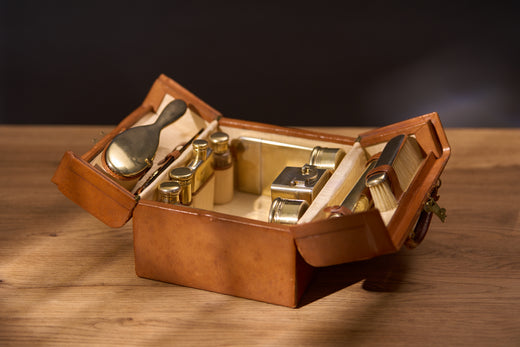
It comes with its original red leather travel case, worn at the edges and intact, and with the factory extract that names its trial, its régleur and its first buyer.
The marks, the movement and the condition are set out piece by piece in the drawers below; the 1953 submission and the delivery record are set out in The Record.
Beneath the case
Open each drawer to look closer

Mark 1
Case no. 666009
Struck on the case interior, cross-referenced to the factory delivery record. The same number appears in the Ulysse Nardin factory extract dated 20 April 1954, confirming this case was delivered directly from Le Locle to the buyer rather than via a retailer.
case no.
factory extract confirmed

Mark 2
Acier Inoxydable stamp
The period marking for Swiss stainless steel used in precision instrument cases. Stainless steel's low magnetic susceptibility made it preferred for 1/10-second chronograph movements where a magnetised balance would corrupt the rating.
stainless steel
period mark

- AGuillaume balanceNickel-steel, self-compensating for middle-temperature error. The choice signals that this movement was adjusted for the full temperature range of the observatory test protocol, not simply rated at a single temperature.
- BNivarox hairspringNivarox is a cobalt-iron-chromium alloy that resists magnetic interference and maintains its elasticity across temperature. Its appearance here on a 1953 competition movement marks the transition from blued-steel springs to modern alloys in Swiss competition watchmaking.
- CColumn wheel, 1/10-second timingThe calibre is marked 1/10-sec: the highest division resolution of any standard UN competition movement in this period. The column-wheel split-seconds operates from the main pusher and the separate rattrapante button on the band.
- D24''' C.C.R. calibreThe in-house designation for this chronograph format: 24-ligne, Column-wheel Chronograph Rattrapante. The approximately 54 mm movement fills the full interior of the 65 mm Goliath case, leaving no visible baseplate from the dial side.
Overall
Excellent.
Case
Stainless steel, screw back seals cleanly, no dents or scratches, sharp edges, light honest wear only.
Dial
White grand feu enamel, perfect, with no hairlines, chips or staining.
Movement
Clean and running well; split-seconds splits, catches up and resets to zero correctly.
Crystal
Clean and intact, no chips or cracks.
Crown / pushers
Winds and sets smoothly; separate rattrapante pusher functions correctly.
65.15
This watch
25.75
€2 coin
A €2 coin is 25.75 mm. This case is more than two and a half times its area.
Room III · The Record

Supplied with the watch. Click to enlarge.
Neuchâtel 1953, factory extract
The Ulysse Nardin factory extract confirms submission to the 1953 Neuchâtel Observatory competition. The extract, not a trade receipt but an internal precision record, was issued from Le Locle and delivered with the watch on 20 April 1954, together with its original red leather travel case. Almost no competition chronometers from this era survive with both their extract and their case intact.
- Maker
- Ulysse Nardin, Le Locle, Switzerland
- Model
- Split-seconds (rattrapante) Chronomètre chronograph
- Calibre
- 24''' C.C.R. 1/10 sec, column-wheel split-seconds, approx. 54mm
- Escapement
- Swiss lever; Guillaume balance; Nivarox hairspring
- Serial
- 127303 (movement and dial)
- Case
- Stainless steel (Acier Inoxydable), open face, screw back, no. 666009
- Diameter
- 65.15mm
- Dial
- White grand feu enamel, Breguet Arabic numerals, rose gold Breguet hands, marked Chronomètre
- Complications
- Split-seconds chronograph, 30-minute recorder, 1/10-second timing
- Year
- 1953 (delivered 20 April 1954)
- Provenance
- Neuchâtel Observatory 1953 competition; Ulysse Nardin factory extract; original red leather travel case
The Estate Collection
Room IV · Acquisition
€18.500
We’d love to discuss our passion for this piece with you.


Ulysse Nardin
€18.500
Enquiry
Split-Seconds Chronometre, Neuchâtel 1953
×