
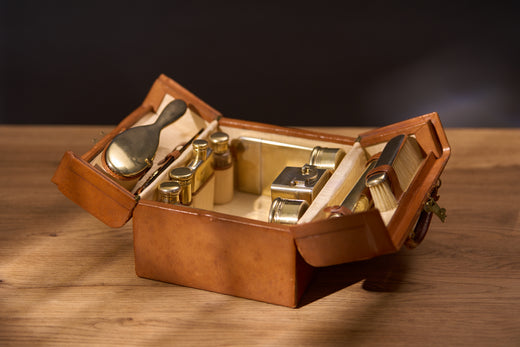

I · The Maker/II · The Object/III · The Record/IV · Acquisition

Room I · The Maker
Zenith, established in Le Locle in 1865, submitted movements to both the Neuchâtel and Besançon observatories across the early twentieth century. The Besançon trials were the French national precision standard, administered by the Observatoire Chronométrique de Besançon, and First Class was its highest distinction. A Zenith First-Class Besançon in split-seconds is one of the more complete combinations of complication and provenance to survive from the 1920s.
The complication · try it
Two hands, one axis
One centre hand stops to mark a split-second; the other keeps running. Press again and it flies back to catch up.
Ready
Press the crown to start.
Running handSplit hand

The Object
A silver split-seconds chronograph by Zenith, timed and certified as a First-Class chronometer at the Besançon Observatory in 1922. It arrives with its own documented observatory record: the paperwork that proves exactly what it is.
A split-seconds chronograph in solid silver by Zenith, made around 1921 and sent, as the best watches of its day were, to be judged. The movement was deposited at the Besançon Observatory in July 1922, rated through the French national trials, and awarded a First-Class bulletin; the archive extract confirming the result, obtained from Besançon itself, accompanies the watch.
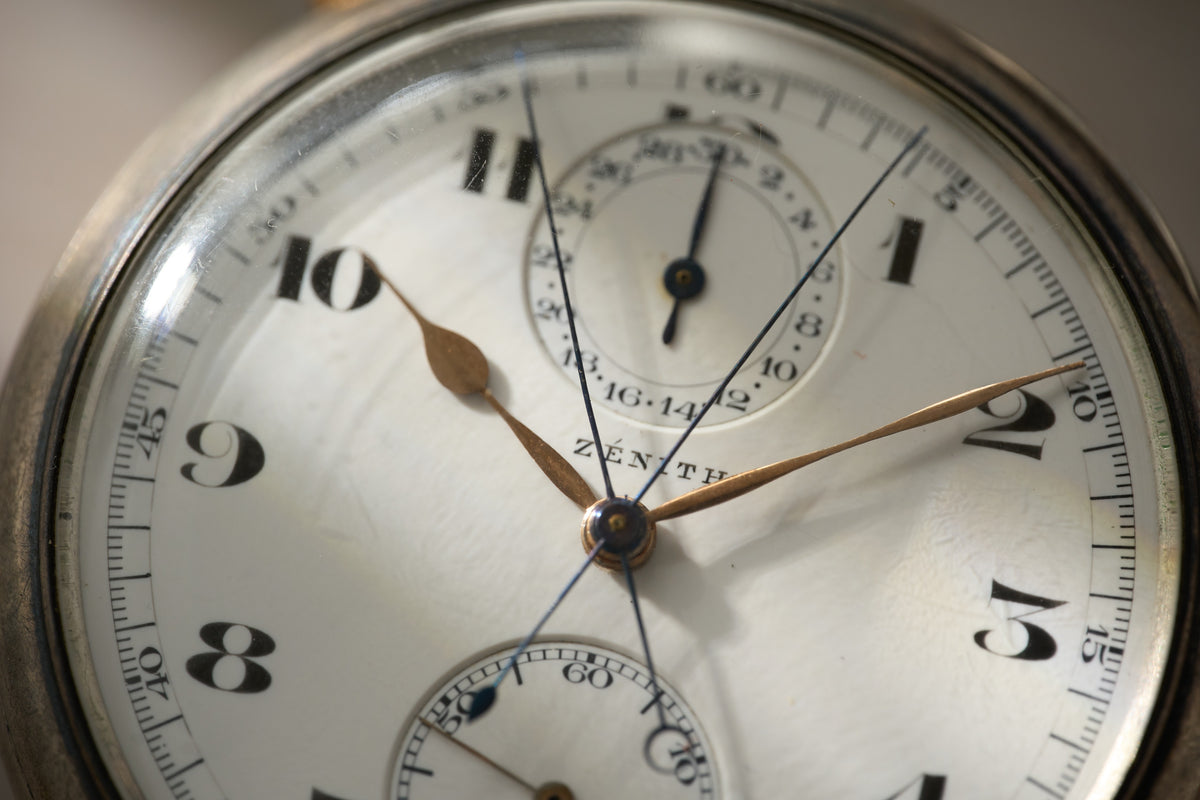
The complication is the rattrapante: two slender blued steel chronograph hands stacked at the centre, one stopping at a press to take a split while the other runs on, then flying back to rejoin it. A thirty-minute register sits at twelve, running seconds at six, and a fifths-of-a-second scale rings the dial. Everything works: the chronograph starts, stops and resets cleanly, and the split hand divides and catches as it was regulated to do a century ago.
The dial is white enamel, clean and bright, signed Zénith in the accented form of the period, its bold Breguet-form numerals under rose gold leaf hands, the one warm note on an instrument face. The case is solid silver, 51.4mm, with an engine-turned barleycorn back and a plain central cartouche that no owner ever engraved. The silver marks are softened by age and present throughout.
A watch sent to an observatory was built above ordinary production and adjusted by a named specialist over weeks of testing; what distinguishes this one is that the proof came home with it, and stayed. It winds, sets and runs correctly, exactly as its bulletin once certified.
The marks, the movement and the condition are set out piece by piece in the drawers below; the Besançon result and archive extract are set out in The Record.
Beneath the case
Open each drawer to look closer

Mark 1
Swiss silver control marks
Multiple Swiss federal silver control marks, worn with age. The Helvetia-head stamp confirms the case metal was assayed by a cantonal office, a legal requirement for all silver sold in Switzerland.
Swiss silver
federal control mark

Mark 2
Case no. 36488
The case number ties the silver shell to the movement serial and the Besançon bulletin. Zenith maintained parallel case and movement records; the cross-reference is the primary tool for distinguishing a competition submission from a standard production piece.
case no. 36488
factory cross-reference

Mark 3
Movement no. 330910
The serial that appears on the movement and in the Besançon Observatory bulletin. The 2023 archive extract from the Besançon city archives was obtained to confirm the result independently; it names the movement, the class and the category in the original French.
serial 330910
Besançon archive confirmed

Mark 4

- ABimetallic compensation balanceThe bimetallic balance has a brass outer ring and steel inner segments; as temperature rises, the segments curl inward to shorten the effective diameter and maintain rate. The technique predates the Guillaume alloy but achieves similar compensation within its operating range.
- BSteel hairspringA flat steel hairspring, adjusted for the Besançon trials. The 1920s Zenith competition movements used steel springs rather than the Nivarox alloys that would follow in the 1930s; the adjuster's skill in temperature compensation was therefore the primary variable.
- CColumn wheel, split-seconds rattrapanteThe chronograph operates from a column wheel, correct for a rattrapante at competition grade. The main chronograph hand and the split-seconds rattrapante both engage cleanly; the 30-minute register records elapsed time to the minute.
- DLever escapementSwiss lever escapement, 18,000 vph. The movement runs, sets and times correctly across all functions. The 1922 Besançon result is a performance record, measured by the observatory rather than claimed by the house.
Case
Solid silver, engine-turned barleycorn back with a blank central cartouche. Light honest surface wear, strong overall; both covers open and close crisply.
Dial
White enamel, excellent and bright. No visible chips or hairlines. Signed Zénith.
Movement
Clean and running well. Column-wheel split-seconds chronograph and 30-minute register fully functional. Bimetallic balance, steel hairspring, lever escapement.
Crystalone honest fault
Intact and clear.
Crownone honest fault
Original, positive action.
Function
Winds, sets and runs correctly. Chronograph starts, stops and resets cleanly.
51.4
This watch
25.75
€2 coin
A €2 coin is 25.75 mm. This case is more than two and a half times its area.
Room III · The Record
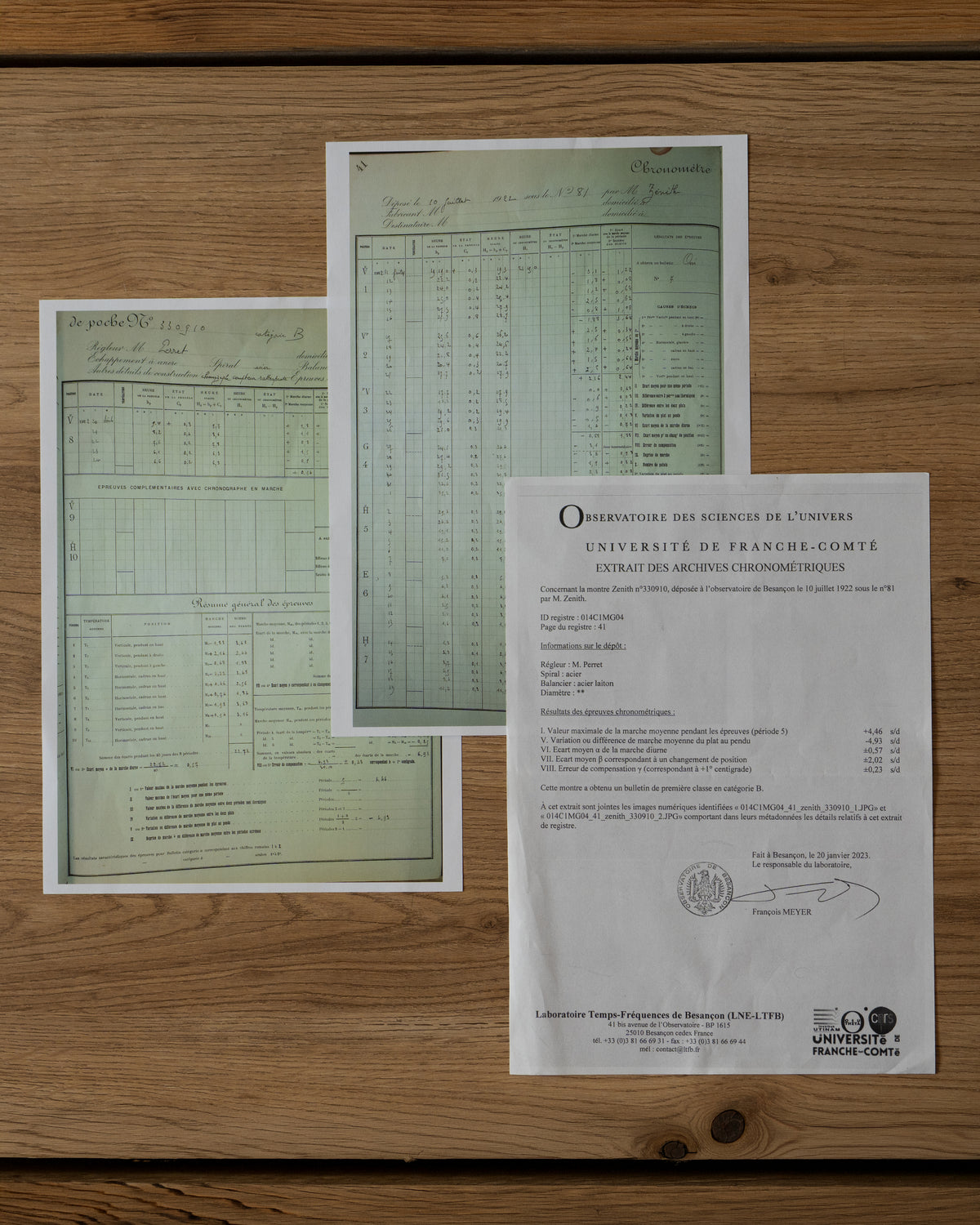
Supplied with the watch. Click to enlarge.
Besançon 1922, First Class, Category B
First-Class chronometer bulletin, Observatoire Chronométrique de Besançon, Category B, 1922. Besançon was the primary French precision timekeeping authority; its First-Class designation required performance across five positions and three temperatures, the same protocol as the Swiss competitions. The bulletin is confirmed by a 2023 archive extract from the Besançon city archives, obtained independently to establish provenance beyond the original paper.
- Maker
- Zenith
- Model
- Split-seconds (rattrapante) chronograph, observatory chronometer
- Year
- C.1922
- Case
- Solid silver (Swiss)
- Diameter
- 51.4 mm
- Movement
- Keyless manual wind, column-wheel split-seconds chronograph, lever escapement, bimetallic compensation balance, steel hairspring
- Complications
- Split-seconds chronograph, 30-minute register, running seconds
- Dial
- White enamel, Breguet-form Arabic numerals, rose gold leaf hands, blued steel split hands, signed Zénith
- Serial
- 330910
- Hallmarks
- Multiple Swiss silver control marks (worn); case no. 36488
- Country
- Switzerland
- Certification
- Besançon Observatory First-Class chronometer bulletin, Category B, 1922 (with 2023 archive extract)
The Estate Collection
Room IV · Acquisition
€12.000
We’d love to discuss our passion for this piece with you.


Zenith
€12.000
Enquiry
Split-Seconds Chronograph, Besançon 1922
×