

How to Read a Hallmark
The five marks inside an English watch case, how to read them, and the full London, Birmingham and Chester date-letter tables from 1776 to 1962.
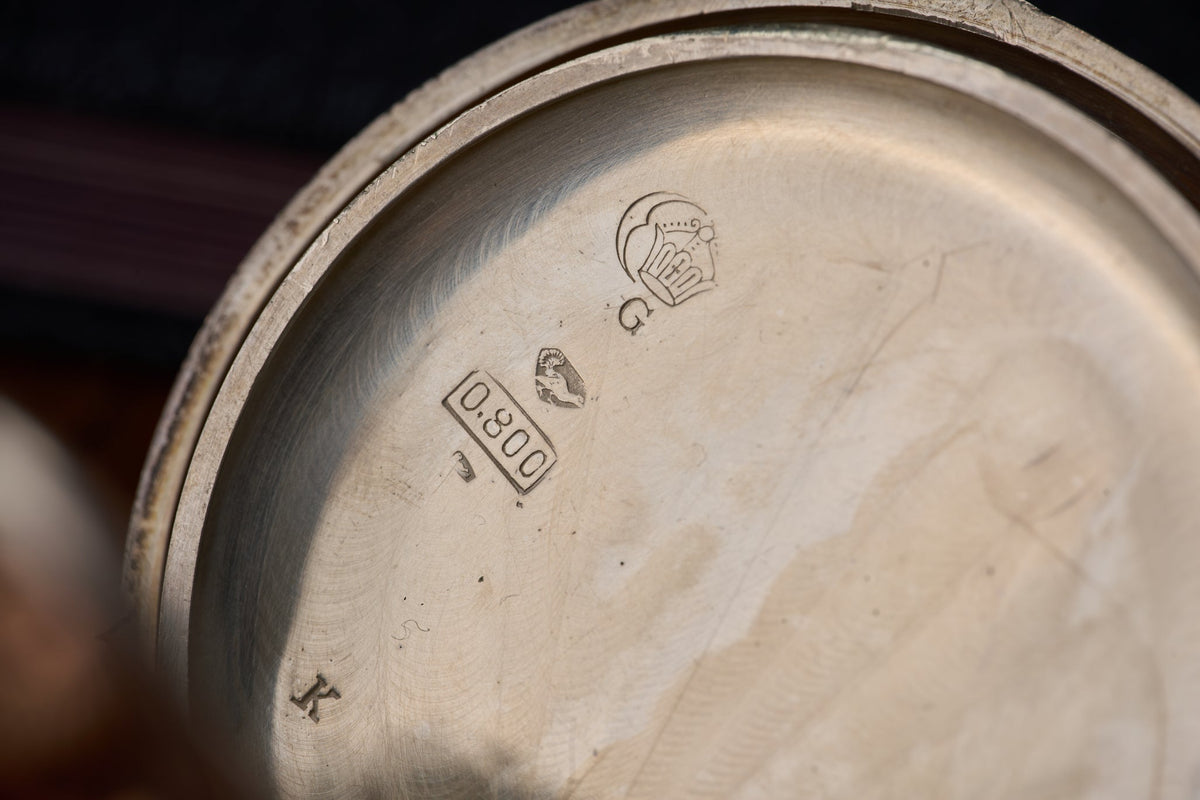
Open the back of an English silver watch and there is a row of tiny punches on the inside of the case, five or six of them, none much bigger than a grain of rice. They were struck by an assay office under an Act of Parliament, and they are the oldest consumer protection still in daily use anywhere. The first of them was ordered by Edward I in 1300. The last Chester punch fell on 24 August 1962. Between those two dates the marks changed shape, gained a king's head, lost it again, and picked up a jubilee or two, but they never stopped saying the same four things: who made this, what it is made of, where it was tested, and when.
This is how we read them, and at the end of the page are the tables we read them with. Nothing here is secret. The letter cycles are public record and have been printed in Jackson's since 1905. What we have done is lay them out for the watch-case trade specifically, the three offices that matter and the years that matter, so that a case can be dated on the bench in under a minute and the answer can be trusted.
Where to look
On a pocket watch the marks are inside the case back, the hinged lid that opens to show the movement. On a hunter or a watch with a cuvette (the inner dust cover) they may be repeated there, and on a good case the bow, the loop the chain passes through, is marked as well. They are small, they are struck in a line, and on a case that has been in a pocket for a hundred and thirty years they are often half worn away. A ten-power loupe and a window are enough. Tilt the case so the light rakes across the surface; a worn punch that is invisible face-on will show its outline in relief.
Read the row twice. Once for what each punch is, once for what they say together, because the shape of one mark is often what settles the meaning of another.
The marks, one by one
- The sponsor's mark. Two or three initials in a shaped cartouche. This is the case maker, or the firm that sent the case for assay, and it is almost never the name on the dial. A Chester or Birmingham case will usually carry the initials of a Coventry or Liverpool case-making house, of which there were dozens, and they can be looked up. The outline of the cartouche is itself a small clue to date, since the shapes changed with fashion.
- The standard mark. For sterling silver in England, a lion walking to the left: the lion passant, in use since 1544. For gold, a crown with the carat figure. Eighteen and twenty-two carat are the old standards; nine, twelve and fifteen carat were made legal in 1854 and carry the figure with its decimal, 9 and .375, 12 and .5, 15 and .625. In 1932 twelve and fifteen were abolished and fourteen carat, .585, took their place. A gold case marked 15 or 12 is therefore between 1854 and 1932, before you have looked at anything else.
- The town mark. A leopard's head for London. An anchor for Birmingham. Three wheatsheaves and a sword, the arms of the city, for Chester. Chester is the one you will see most on English watch cases from the 1860s to the 1920s, because the case trade of Liverpool and Coventry sent its work there, and Chester struck it in enormous quantity. Sheffield's rose, Edinburgh's castle and Dublin's crowned harp turn up on watches rarely.
- The date letter. A single letter of the alphabet, changed once a year, in a typeface and a shield that change with every cycle. This is the punch that gives the year, and it is the one that needs a table. Everything else on the page is in service of reading it correctly.
- The duty mark. The sovereign's head in profile: George III, George IV, William IV, Victoria. Struck on silver and gold from 1 December 1784 to 30 April 1890 to show that the excise duty had been paid. The head alone puts a case before or after 1890, and very often that is enough to tell you which cycle a letter belongs to.
- The commemoratives. Optional, and rare on watches. The two heads of George V and Queen Mary for the Silver Jubilee, used 1934 to 1936, and the head of Elizabeth II for the Coronation, used 1952 to 1954.
Two things to know before you open the tables
The hallmarking year is not the calendar year
Each office changed its letter part-way through the year, so one letter always covers parts of two calendar years. London changed on 29 May, from the day the new wardens of the Goldsmiths' Company took office, until 1974. Birmingham changed in July. Chester changed on 5 July until 1839, then on 5 August until 1889, then on 1 July from 1890. The year in the tables is the year the letter was introduced. A case carrying it may have been assayed in the first half of the following year, which is why a careful description says "Chester 1895" and means July 1895 to June 1896. From 1975 every office changed on 1 January and the ambiguity disappeared.
Every letter comes round again, so find the cycle first
London used A in 1776, 1796, 1816, 1836 and so on; Chester used M in 1895, 1912, 1937 and 1962. A letter on its own is not a date. Before you look it up, decide which cycle it belongs to, from four things: whether it is a capital or a lower-case letter; whether the face is Roman, Old English black-letter or cursive; the outline of the shield it sits in; and whether there is a duty head beside it. Then, if there is still a doubt, let the watch itself vote. A Swiss keyless lever does not live in an 1839 case, and a verge does not live in a 1926 one.
The offices also skipped letters. London never used J and stopped at U, so its cycles are twenty years long. Birmingham and Chester ran to Z but usually dropped J; in the cycles beginning 1925 and 1926 they dropped I instead and used J. Each column heading below says which.
The tables
London: leopard's head
Twenty letters a cycle, A to U with J omitted. Cycles begin 1776, 1796, 1816, 1836, 1856, 1876, 1896, 1916 and 1936. The shields around the lion and the leopard changed with each cycle as well, and the leopard lost its crown in 1821.
| 1776-1795 lower-case Roman |
1796-1815 capital Roman |
1816-1835 lower-case Roman |
1836-1855 capital Old English |
1856-1875 lower-case Old English |
1876-1895 capital Roman |
1896-1915 lower-case Roman |
1916-1935 lower-case sans-serif |
1936-1955 capital Roman |
|---|---|---|---|---|---|---|---|---|
| a 1776 | A 1796 | a 1816 | A 1836 | a 1856 | A 1876 | a 1896 | a 1916 | A 1936 |
| b 1777 | B 1797 | b 1817 | B 1837 | b 1857 | B 1877 | b 1897 | b 1917 | B 1937 |
| c 1778 | C 1798 | c 1818 | C 1838 | c 1858 | C 1878 | c 1898 | c 1918 | C 1938 |
| d 1779 | D 1799 | d 1819 | D 1839 | d 1859 | D 1879 | d 1899 | d 1919 | D 1939 |
| e 1780 | E 1800 | e 1820 | E 1840 | e 1860 | E 1880 | e 1900 | e 1920 | E 1940 |
| f 1781 | F 1801 | f 1821 | F 1841 | f 1861 | F 1881 | f 1901 | f 1921 | F 1941 |
| g 1782 | G 1802 | g 1822 | G 1842 | g 1862 | G 1882 | g 1902 | g 1922 | G 1942 |
| h 1783 | H 1803 | h 1823 | H 1843 | h 1863 | H 1883 | h 1903 | h 1923 | H 1943 |
| i 1784 | I 1804 | i 1824 | I 1844 | i 1864 | I 1884 | i 1904 | i 1924 | I 1944 |
| k 1785 | K 1805 | k 1825 | K 1845 | k 1865 | K 1885 | k 1905 | k 1925 | K 1945 |
| l 1786 | L 1806 | l 1826 | L 1846 | l 1866 | L 1886 | l 1906 | l 1926 | L 1946 |
| m 1787 | M 1807 | m 1827 | M 1847 | m 1867 | M 1887 | m 1907 | m 1927 | M 1947 |
| n 1788 | N 1808 | n 1828 | N 1848 | n 1868 | N 1888 | n 1908 | n 1928 | N 1948 |
| o 1789 | O 1809 | o 1829 | O 1849 | o 1869 | O 1889 | o 1909 | o 1929 | O 1949 |
| p 1790 | P 1810 | p 1830 | P 1850 | p 1870 | P 1890 | p 1910 | p 1930 | P 1950 |
| q 1791 | Q 1811 | q 1831 | Q 1851 | q 1871 | Q 1891 | q 1911 | q 1931 | Q 1951 |
| r 1792 | R 1812 | r 1832 | R 1852 | r 1872 | R 1892 | r 1912 | r 1932 | R 1952 |
| s 1793 | S 1813 | s 1833 | S 1853 | s 1873 | S 1893 | s 1913 | s 1933 | S 1953 |
| t 1794 | T 1814 | t 1834 | T 1854 | t 1874 | T 1894 | t 1914 | t 1934 | T 1954 |
| u 1795 | U 1815 | u 1835 | U 1855 | u 1875 | U 1895 | u 1915 | u 1935 | U 1955 |
Birmingham: anchor
Office opened 31 August 1773, the same year as Sheffield, after Matthew Boulton petitioned Parliament for an assay office nearer his works. Cycles of twenty-five or twenty-six letters. The anchor is said to have been chosen because the London lobbying was done from the Crown and Anchor tavern; Sheffield took the crown.
| 1773-1797 capital Roman |
1798-1823 lower-case Roman, all 26 letters |
1824-1848 capital Roman |
1849-1874 capital Old English, all 26 letters |
1875-1899 lower-case Roman |
1900-1924 lower-case Roman |
1925-1949 capital Roman (I omitted, J used) |
|---|---|---|---|---|---|---|
| A 1773 | a 1798 | A 1824 | A 1849 | a 1875 | a 1900 | A 1925 |
| B 1774 | b 1799 | B 1825 | B 1850 | b 1876 | b 1901 | B 1926 |
| C 1775 | c 1800 | C 1826 | C 1851 | c 1877 | c 1902 | C 1927 |
| D 1776 | d 1801 | D 1827 | D 1852 | d 1878 | d 1903 | D 1928 |
| E 1777 | e 1802 | E 1828 | E 1853 | e 1879 | e 1904 | E 1929 |
| F 1778 | f 1803 | F 1829 | F 1854 | f 1880 | f 1905 | F 1930 |
| G 1779 | g 1804 | G 1830 | G 1855 | g 1881 | g 1906 | G 1931 |
| H 1780 | h 1805 | H 1831 | H 1856 | h 1882 | h 1907 | H 1932 |
| I 1781 | i 1806 | I 1832 | I 1857 | i 1883 | i 1908 | J 1933 |
| K 1782 | j 1807 | K 1833 | J 1858 | k 1884 | k 1909 | K 1934 |
| L 1783 | k 1808 | L 1834 | K 1859 | l 1885 | l 1910 | L 1935 |
| M 1784 | l 1809 | M 1835 | L 1860 | m 1886 | m 1911 | M 1936 |
| N 1785 | m 1810 | N 1836 | M 1861 | n 1887 | n 1912 | N 1937 |
| O 1786 | n 1811 | O 1837 | N 1862 | o 1888 | o 1913 | O 1938 |
| P 1787 | o 1812 | P 1838 | O 1863 | p 1889 | p 1914 | P 1939 |
| Q 1788 | p 1813 | Q 1839 | P 1864 | q 1890 | q 1915 | Q 1940 |
| R 1789 | q 1814 | R 1840 | Q 1865 | r 1891 | r 1916 | R 1941 |
| S 1790 | r 1815 | S 1841 | R 1866 | s 1892 | s 1917 | S 1942 |
| T 1791 | s 1816 | T 1842 | S 1867 | t 1893 | t 1918 | T 1943 |
| U 1792 | t 1817 | U 1843 | T 1868 | u 1894 | u 1919 | U 1944 |
| V 1793 | u 1818 | V 1844 | U 1869 | v 1895 | v 1920 | V 1945 |
| W 1794 | v 1819 | W 1845 | V 1870 | w 1896 | w 1921 | W 1946 |
| X 1795 | w 1820 | X 1846 | W 1871 | x 1897 | x 1922 | X 1947 |
| Y 1796 | x 1821 | Y 1847 | X 1872 | y 1898 | y 1923 | Y 1948 |
| Z 1797 | y 1822 | Z 1848 | Y 1873 | z 1899 | z 1924 | Z 1949 |
| z 1823 | Z 1874 |
Chester: three wheatsheaves and a sword
The watch-case office. Closed 24 August 1962, so a Chester K, L or M of 1960 to 1962 is among the last Chester silver ever struck. In the 1818 cycle the letter D ran from 8 November 1821 to 5 July 1823 and stands for both 1821 and 1822. The cursive capitals of 1901 to 1925 repeat the cursive cycle of 1726 to 1750, but the earlier cycle carries a crowned leopard's head beside the wheatsheaves and the two are not confused in practice.
| 1776-1796 lower-case Roman |
1797-1817 capital Roman |
1818-1838 capital Roman |
1839-1863 capital Roman |
1864-1883 lower-case Roman |
1884-1900 capital Roman |
1901-1925 capital cursive |
1926-1950 capital Roman (I omitted, J used) |
1951-1962 capital Roman (I omitted, J used) |
|---|---|---|---|---|---|---|---|---|
| a 1776 | A 1797 | A 1818 | A 1839 | a 1864 | A 1884 | A 1901 | A 1926 | A 1951 |
| b 1777 | B 1798 | B 1819 | B 1840 | b 1865 | B 1885 | B 1902 | B 1927 | B 1952 |
| c 1778 | C 1799 | C 1820 | C 1841 | c 1866 | C 1886 | C 1903 | C 1928 | C 1953 |
| d 1779 | D 1800 | D 1821-22 | D 1842 | d 1867 | D 1887 | D 1904 | D 1929 | D 1954 |
| e 1780 | E 1801 | E 1823 | E 1843 | e 1868 | E 1888 | E 1905 | E 1930 | E 1955 |
| f 1781 | F 1802 | F 1824 | F 1844 | f 1869 | F 1889 | F 1906 | F 1931 | F 1956 |
| g 1782 | G 1803 | G 1825 | G 1845 | g 1870 | G 1890 | G 1907 | G 1932 | G 1957 |
| h 1783 | H 1804 | H 1826 | H 1846 | h 1871 | H 1891 | H 1908 | H 1933 | H 1958 |
| i 1784 | I 1805 | I 1827 | I 1847 | i 1872 | I 1892 | I 1909 | J 1934 | J 1959 |
| k 1785 | K 1806 | K 1828 | K 1848 | k 1873 | K 1893 | K 1910 | K 1935 | K 1960 |
| l 1786 | L 1807 | L 1829 | L 1849 | l 1874 | L 1894 | L 1911 | L 1936 | L 1961 |
| m 1787 | M 1808 | M 1830 | M 1850 | m 1875 | M 1895 | M 1912 | M 1937 | M 1962 |
| n 1788 | N 1809 | N 1831 | N 1851 | n 1876 | N 1896 | N 1913 | N 1938 | |
| o 1789 | O 1810 | O 1832 | O 1852 | o 1877 | O 1897 | O 1914 | O 1939 | |
| p 1790 | P 1811 | P 1833 | P 1853 | p 1878 | P 1898 | P 1915 | P 1940 | |
| q 1791 | Q 1812 | Q 1834 | Q 1854 | q 1879 | Q 1899 | Q 1916 | Q 1941 | |
| r 1792 | R 1813 | R 1835 | R 1855 | r 1880 | R 1900 | R 1917 | R 1942 | |
| s 1793 | S 1814 | S 1836 | S 1856 | s 1881 | S 1918 | S 1943 | ||
| t 1794 | T 1815 | T 1837 | T 1857 | t 1882 | T 1919 | T 1944 | ||
| u 1795 | U 1816 | U 1838 | U 1858 | u 1883 | U 1920 | U 1945 | ||
| v 1796 | V 1817 | V 1859 | V 1921 | V 1946 | ||||
| W 1860 | W 1922 | W 1947 | ||||||
| X 1861 | X 1923 | X 1948 | ||||||
| Y 1862 | Y 1924 | Y 1949 | ||||||
| Z 1863 | Z 1925 | Z 1950 |
What the marks cannot tell you
A hallmark dates the case, and only the case, and only to the day it went through the assay office. Case makers stocked blanks and sent them in batches, so a case can be a season older than its letter. The movement inside is a separate object with a separate history. English cases were fitted with Swiss movements in vast numbers from the 1860s onward, and a Chester 1895 case around a Swiss lever is not a marriage, it is how the trade worked. Where the case and the movement disagree by decades, though, or where the case has a second set of screw holes for a movement it no longer holds, the watch has been assembled from parts and should be described as such.
From 1 June 1907 foreign-made cases imported into Britain had to be assayed here too, and they were given their own import marks, different from the domestic ones, so that a Swiss gold case sold in London after 1907 can carry British marks without ever having been made here. Continental cases follow other systems entirely: French guarantee marks, Swiss export standards, the unmarked American gold-filled case with its twenty-year warranty stamped inside. Those are other pages.
A case read from start to finish
A silver open-face watch. Inside the back: a lion passant; three wheatsheaves with a sword; a plain capital Roman M; the initials of a Coventry case maker in an oval; no sovereign's head.
The wheatsheaves say Chester. No duty head says after April 1890. Chester struck a capital M in 1895, 1912, 1937 and 1962. The 1912 letter is cursive, so it is out. The movement is a Swiss lever of the kind imported by the thousand in the 1890s, which rules out 1937 and 1962 before the shield outlines need to be compared. The case was assayed between 1 July 1895 and 30 June 1896. The watch is described as Chester 1895, and the description is right.
That is the whole method: find the office, find the cycle, read the letter, then let the rest of the watch confirm it. After a few dozen cases the shapes stop needing the table and the table becomes a check rather than a crutch. Until then it is here, and it is not going anywhere.
The cycles above were compiled from the London, Birmingham and Chester assay registers as published in Jackson's Silver and Gold Marks and in the silvermakersmarks.co.uk date-letter tables, and checked cycle by cycle. Changeover dates per the Birmingham and Chester assay office records. If you have a case that does not fit, we would like to see it.