
The Repeater Watch
Before the electric light, telling the time in darkness meant lighting a candle, or owning a repeater. A mechanism that strikes the hours, quarters, and minutes on demand, the repeating watch is one of the most demanding complications in all of horology, and one of the most human.
The problem it solved
We carry the assumption of visible time so casually now that the original problem is easy to miss. For most of the history in which pocket watches existed, reading one required light. In the hours between dusk and dawn, in a bedroom, at a theatre, in a carriage moving without lanterns, the watch face told you nothing. A striking mechanism that could be activated on demand changed that entirely.
The repeating watch was not a curiosity. For those who could afford one, it was a genuinely practical instrument, and the fact that it was also extraordinary to own and extraordinarily difficult to make did nothing to diminish the demand for it.
How it works
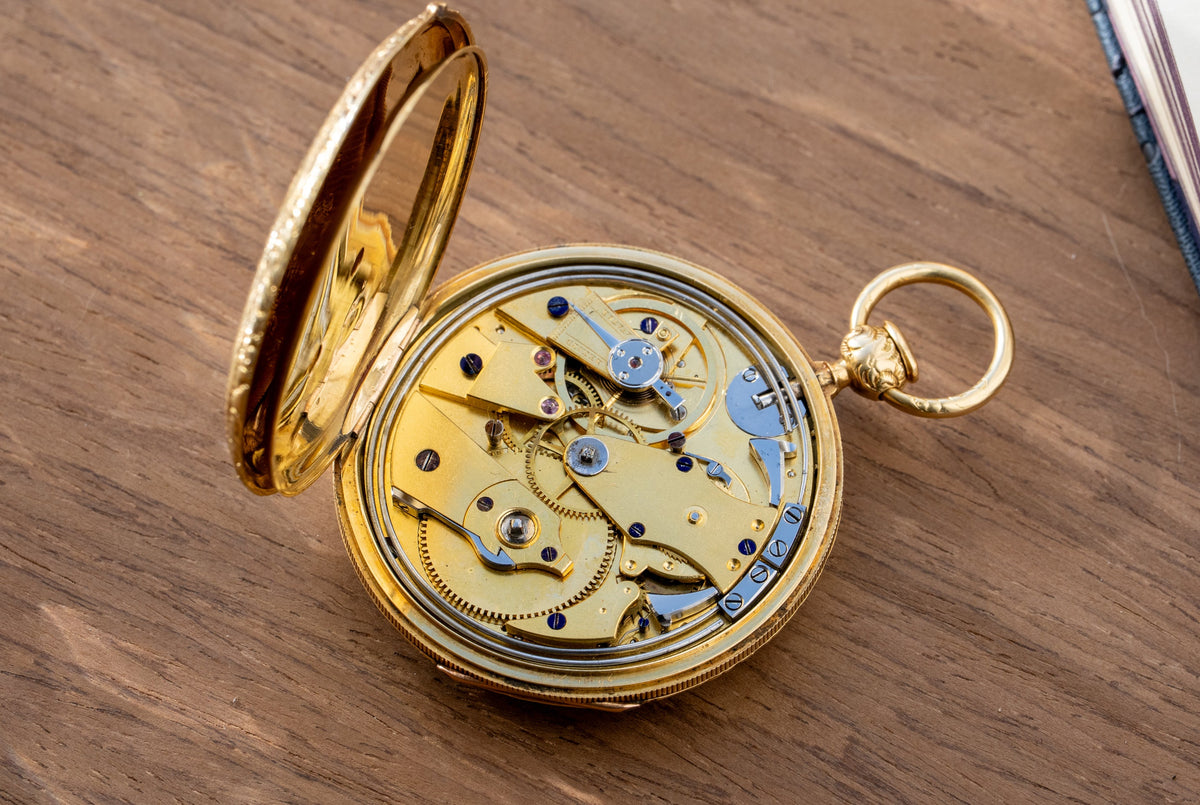
A repeater is triggered by sliding a push-piece, usually a slide in the band of the case, which winds a small subsidiary spring. As this spring releases, it drives a train of wheels connected to a set of hammers that strike against one or two gongs: curved wires fixed inside the case whose resonance produces the tone. The mechanism reads the position of the hands at the moment of activation and translates that position into a sequence of strikes.
The quarter repeater
The simplest form is the quarter repeater, which strikes the hours in a single tone and the quarters in a double tone. A watch striking one low note followed by two double notes is reading one fifteen, one hour, two quarters past.
The half-quarter repeater
The half-quarter repeater adds a further subdivision, striking an additional note if more than seven and a half minutes have elapsed since the last quarter. These are uncommon and mark a transitional point in the development of the mechanism.
The five-minute repeater
The five-minute repeater strikes the hours, the quarters, and then additional single notes for each five-minute interval elapsed since the last quarter, allowing the time to be read to within five minutes by ear.
The minute repeater
The minute repeater is the apex of the form. It strikes the hours, then the quarters, then single notes for every minute elapsed since the last quarter, allowing the precise time to be sounded on demand. A minute repeater striking two hours, three quarters, and seven minutes produces: two slow notes, three pairs of notes (high-low), seven high notes. The trains required to read, register, and transmit that information, compressed into a movement already containing a timekeeping mechanism, represent some of the most refined mechanical thinking in watchmaking history.
The makers and the period
Repeating mechanisms were developed in England in the late seventeenth century, with Daniel Quare and Edward Barlow both claiming priority for the pocket repeater around 1686 to 1687. The mechanism was refined extensively through the eighteenth century, with English and Swiss makers competing on the quality and compactness of their work. By the nineteenth century, Switzerland had become the dominant producer of repeating watches, with the workshops of the Vallée de Joux producing the great majority of repeating movements found in pocket watches of that era.
The arrival of luminous dials in the early twentieth century, and then the ubiquity of artificial light more broadly, made the practical case for repeaters obsolete. Production declined sharply after the First World War, and the finest examples of the mechanism now rest in collections and on the secondary market, where they occupy a distinct and significant category.
What to listen for
A repeater in good order produces a clear, sustained tone without buzz or chatter. The strike should be even, the sequence distinct, and the mechanism should activate and complete without hesitation. A slide that is stiff, a strike that is muffled, or a sequence that runs in the wrong order are all signs of a mechanism that needs attention, not unusual in a watch of this age and complexity, but worth understanding before purchase. In the collection, repeaters are described with their strike condition noted explicitly.