

I · The Maker/II · The Object/III · The Record/IV · Acquisition

Room I · The Maker
Fromanteel is among the foundational names in horology: Ahasuerus Fromanteel made the first pendulum clocks in Britain in 1658. His family carried the trade to Amsterdam, and from 1694 the household clockmaker Christopher Clarke worked with them as "Fromanteel & Clarke" in both cities until about 1722, the first horological firm to trade internationally. This movement carries that signature. The silver pair cases are later, struck with nineteenth-century Dutch marks, so the watch survives as an early Anglo-Dutch movement in Dutch silver of a later date.
The Complication · Listen
Hear it strike
A repeater sounds the hours and quarters on tuned gongs at the press of a slide, a mechanism made, before electric light, for telling the time in the dark by ear alone.
We’ll send you this watch striking the hours and quarters.
The Object
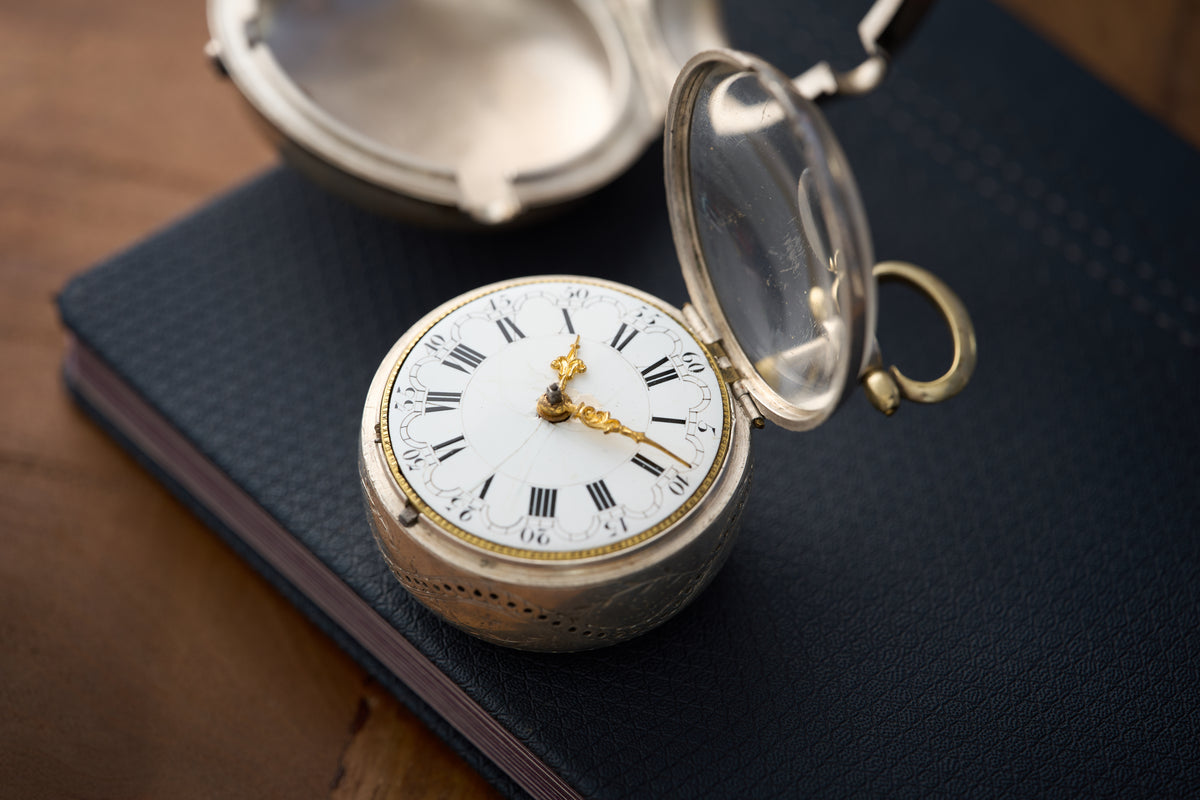
A quarter-repeating verge watch that strikes the hours and quarters on a bell, signed Fromanteel & Clarke, the Anglo-Dutch house descended from the maker of Britain's first pendulum clocks. Arcaded white enamel dial and gilt beetle-and-poker hands, in later Dutch silver.
It is a repeating watch. Work the slide set into the case band and it strikes the hour on a bell, then the quarters, so the time can be read by ear in the dark. A striking watch was among the most complicated things a maker could attempt in the early eighteenth century, and it is the reason the case band is pierced: the frets let the bell be heard. Few verge watches of the period carry the work. It is large, a full 61mm across, open-faced and wound by key, with no crown.
The dial is white enamel in the arcaded manner, black Roman hours within a scalloped chapter and an outer ring of Arabic minutes counted in fives, each figure set in a shallow wave. Gilt beetle-and-poker hands sit over it, the hour a chased fleur, the minute a tapering poker, cast and dressed by hand. The enamel carries the hairlines of its age and a small loss beside the centre, set down plainly in the condition report; the black on white still reads at a glance.
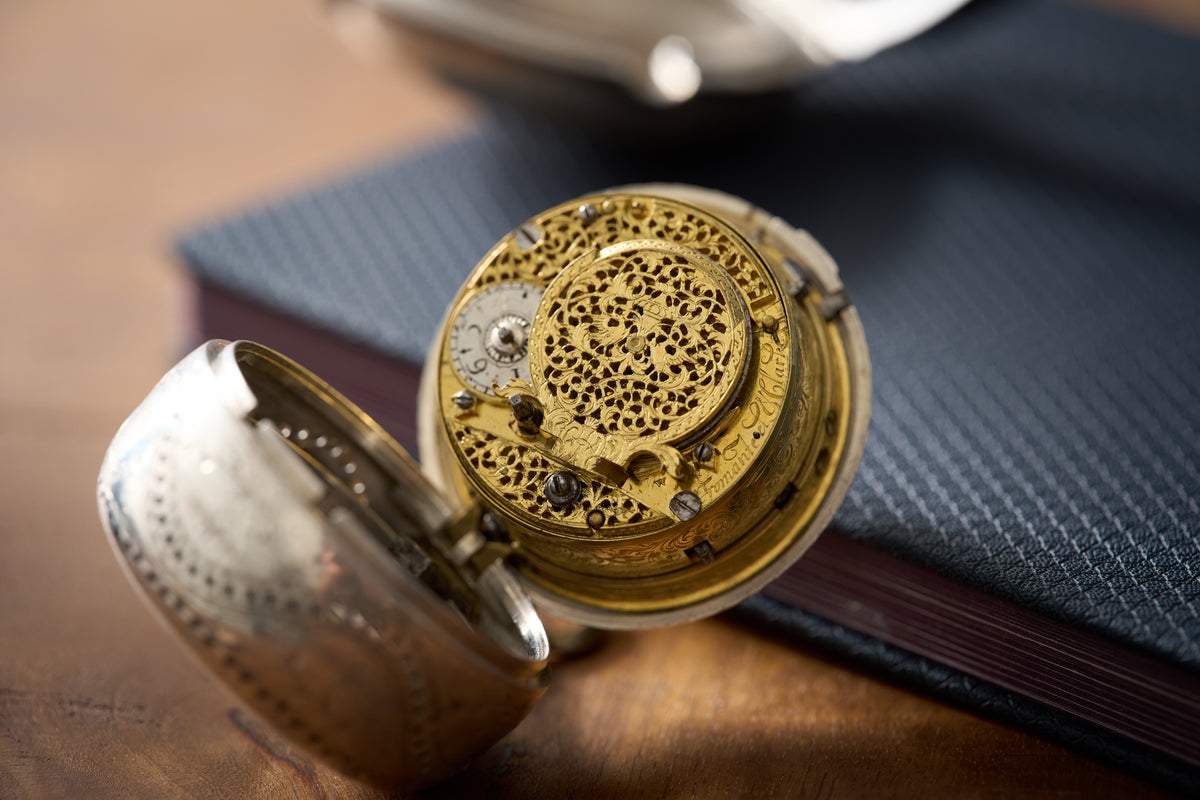
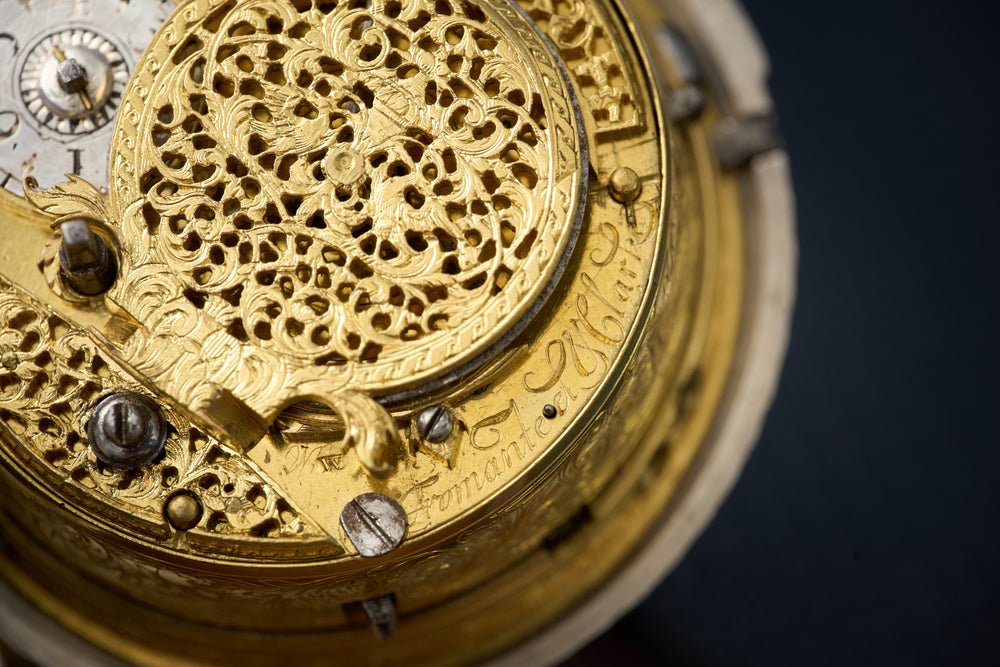
Through the back is the work that matters. A full gilt plate fills the case, and over the balance sits a cock pierced and engraved edge to edge with foliage, a silvered regulator disc numbered beside it. The very edge of the plate is engraved too, a running frieze of birds and scrollwork meant for whoever opened the watch and no one else. The repeat train and its rack sit within, driving the hammer to the bell, which is mounted over the movement and struck on its rim. Across the plate runs the signature, in flowing script, Fromanteel & Clarke: the Anglo-Dutch house that reached back to the maker of Britain's first pendulum clocks and kept a shop in Amsterdam as well as London. An engraved W keeps it company, a workshop hand that left no fuller name.
The silver that holds all this is younger than the movement. Its marks are Dutch and of the nineteenth century, so at some point in Holland the old watch was given fresh cases and kept in use, which for an Anglo-Dutch maker is a fitting place to have ended up. That is the honest shape of the piece: an early bell-striking repeater in later Dutch silver, working, whole and together. The marks, the movement and the condition are set out in the drawers below.
Beneath the case
Open each drawer to look closer
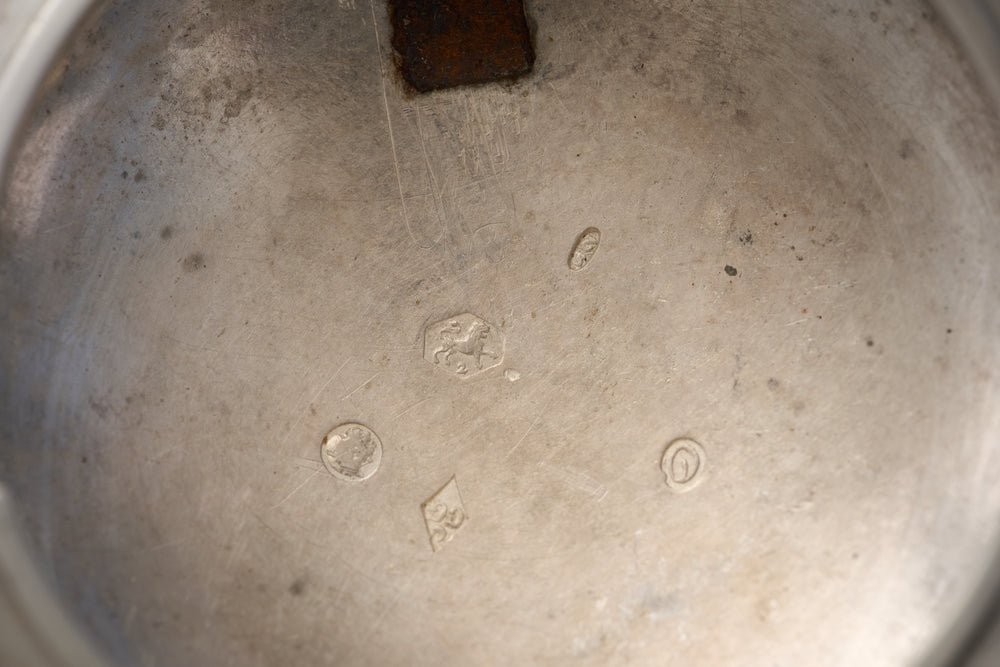
Mark 1
Dutch lion with 2
The Dutch lion passant over the figure 2, the second silver standard of .833, a control mark used from 1814 and the reason the cases are read as nineteenth century.
Dutch
.833
from 1814
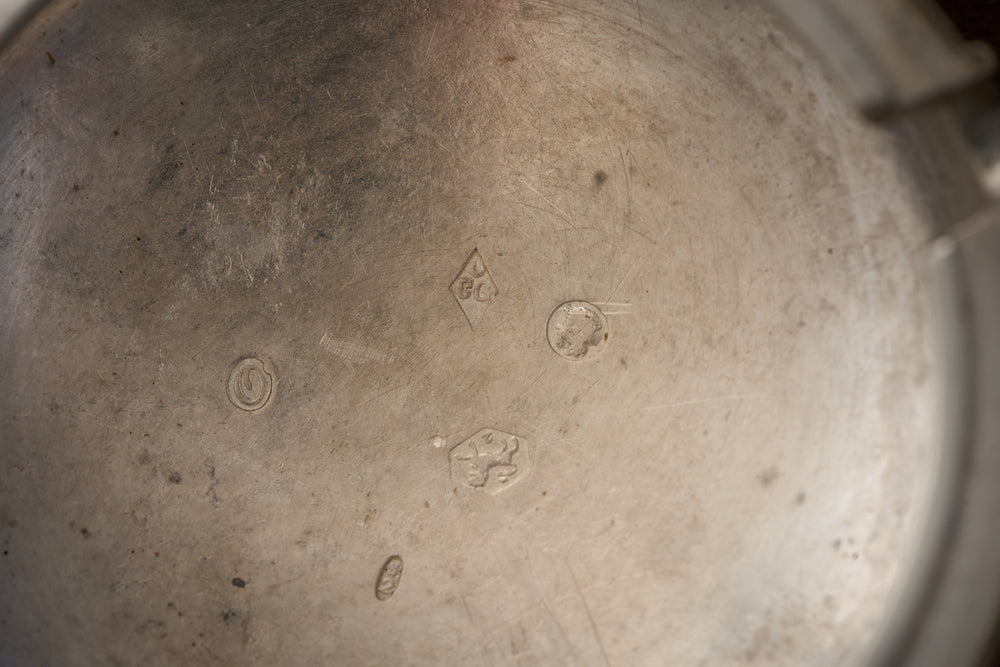
Mark 2
CG in a lozenge, crescent above
The letters CG in a lozenge with a crescent above, a maker's or assay punch of the Dutch system.
lozenge
crescent
Mark 3
S2 in an oval
An oval punch reading S2, a further control or maker's mark on the case.
oval
control mark
The Movement
Photography coming soon
This movement is awaiting its studio session.
Caseone honest fault
Very good
Both silver pair cases sound and closing correctly; honest surface wear and light scratching consistent with age; engraved sunburst to the outer back, pierced sound-fret band, beaded borders; two-tone gilt and silver bow.
Dialone honest fault
Good
White enamel, arcaded; multiple hairlines radiating from the centre and a chip with enamel loss just to the right of the centre arbor; legible and clean otherwise.
Movement
Excellent
Full-plate gilt quarter-repeating verge signed Fromanteel & Clarke; runs, winds and sets correctly, and the quarter repeat strikes the hours and quarters on the bell via the case-band slide; pierced and engraved balance cock, silvered regulator disc, engraved band.
Crystal
Excellent
High-domed bull's-eye crystal, intact.
Crown
None fitted, key-wind and key-set by original design.
61.31
This watch
25.75
€2 coin
A €2 coin is 25.75 mm. This case is more than two and a half times its area.
Room III · The Record
Signed Fromanteel & Clarke, an early bell-striking repeater in Dutch silver.
The movement is signed across the plate, the Anglo-Dutch partnership active in Amsterdam and London between 1694 and about 1722, descended from Ahasuerus Fromanteel, maker of Britain's first pendulum clocks. The firm did not usually mark a place on its watches, and this one carries none. An engraved W stands beside the signature, a workshop mark left unattributed. The quarter repeat strikes the hours and quarters on a bell. The silver pair cases are struck with the Dutch lion and the figure 2 for the second silver standard, a control mark used from 1814, so the cases are later than the movement. Acquired from a private collection.
- Maker
- Fromanteel & Clarke (signed)
- Model
- Quarter-repeating verge in pair cases
- Complication
- Quarter repeater, striking hours and quarters on a bell
- Movement
- Verge, key-wound, full plate, gilt
- Dial
- White enamel, arcaded; Roman hours, Arabic minute ring
- Hands
- Gilt beetle-and-poker
- Case
- Silver pair cases, open face; pierced sound-fret band
- Case marks
- Dutch, .833 second standard (lion and 2), 19th century
- Diameter
- 61.31mm
- Date
- Movement early 18th century, c.1705-1720; cases 19th-century Dutch
- Country
- England / Netherlands (Amsterdam-London)
The Estate Collection
Room IV · Acquisition
Price on Request
We’d love to discuss our passion for this piece with you.


Fromanteel & Clarke
Price on Request
Enquiry
Quarter Repeater, c.1710
×