

I · The Maker/II · The Object/III · The Calibre/IV · Acquisition

Room I · The Maker
Piaget, founded in the Jura village of La Côte-aux-Fées in 1874, spent the twentieth century turning ultra-thin watchmaking into an art and then dressing it in gold. The envelope is that philosophy in miniature: an entire mechanical watch made to disappear inside a woven gold case no larger than a card. Few things the Maison made are as quietly theatrical, at rest a small woven envelope, and at the press of a flap, a watch that rises to meet you.


The Object
Push the centre of the woven gold flap and a Piaget watch rises to meet you. Solid 18k gold, a blue sapphire cabochon crown, and the record-setting ultra-thin calibre 9P hidden inside.
At rest it is a small envelope of woven 18k gold, about the size of a matchbook, its basketweave worked by hand and framed with a bright polished border. Press the centre of the flap and it opens: the watch inside lifts on its hinge and stands upright, a white dial with black Roman numerals and blued steel hands, signed Piaget. Read the time, close the flap, and the watch disappears back into the gold.
Piaget made very few objects this quietly theatrical. The envelope belongs to the Maison's great decade of dressed-up watchmaking, made around 1965 as a travel and desk piece for people who wanted the time nearby but not on show: on a night table, in a jacket pocket, beside a hotel telephone. The winding crown is set with a sapphire cabochon, the small blue full stop Piaget put on its dress pieces, and a French owl import mark is tucked into the weave, the trace of the watch's journey when it was new.
The reason the trick works at all is a movement thin enough to vanish inside a case the depth of a few stacked coins; its story is told in The Calibre below. What matters in the hand is the object itself: 42.7 by 31.1 millimetres of woven gold, dense, hinged and precise, as much goldsmithing as watchmaking.
Complete, honest examples are not easy to find, because these were used: carried, packed, opened a dozen times a day. This one has survived with the weave even and intact, the polished borders bright and the dial clean, and it winds and runs correctly. It keeps its original black Piaget pouch.
The marks, the movement and the condition are set out piece by piece in the drawers below; the movement's story is told in The Calibre.
Beneath the case
Open each drawer to look closer
Mark 1
18k gold, 0750
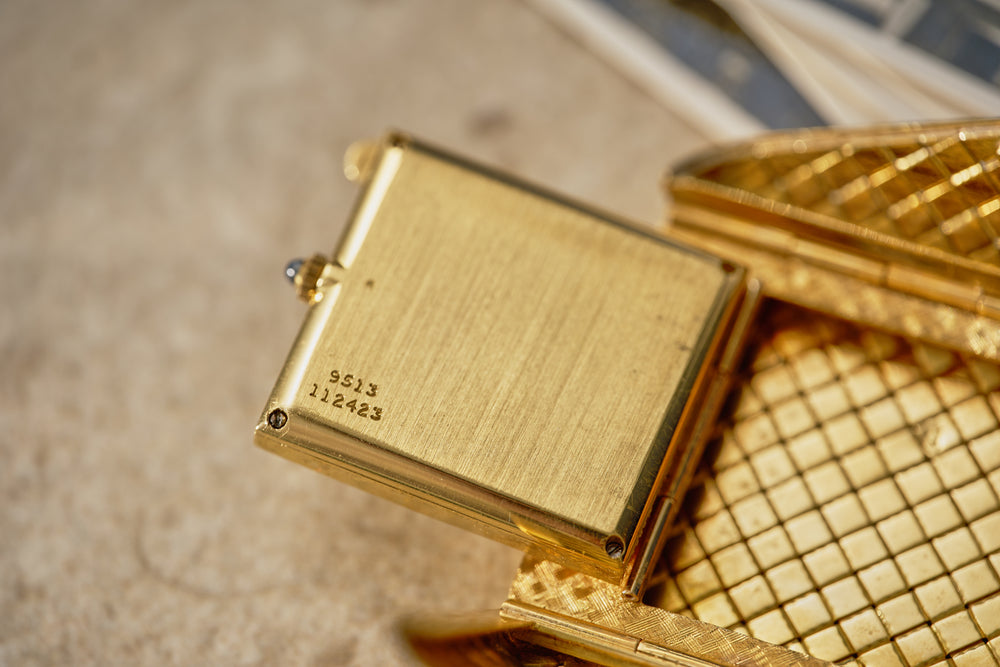
The case is stamped 0750 for 18 carat gold, the woven surface worked by hand and framed by a bright polished border.
18k gold 0750
woven case

Mark 2
PIAGET, case no. 112423
The Piaget signature and the case number, marking the piece as the Reference 9513 envelope form watch made around 1965.
Ref. 9513
case 112423

Mark 3
French hibou import mark
A French hibou (owl) import assay mark is tucked within the weave, the stamp applied to gold of foreign manufacture entering France, so the watch was imported into and assayed in France.
hibou import mark
assayed in France

Mark 4
The Movement
Photography coming soon
This movement is awaiting its studio session.
Overall
Excellent
In running order, complete with its original black Piaget pouch.
Case
Excellent
Woven 18k yellow gold, weave even and intact, bright polished borders, only light honest surface marks consistent with age and use.
Dial
Excellent
White with black Roman numerals and blued steel hands, PIAGET signed, clean and crisp.
Movement
Excellent
Piaget calibre 9P, hand-wound, 18 jewels; runs and winds correctly.
Crystal
Excellent
Clear, no notable damage.
Crown
Excellent
Blue sapphire cabochon, functions correctly.
Room III · The Calibre
Calibre 9P, the movement that made Piaget's name
Behind the dial sits the calibre 9P, introduced in 1957 at just 2 mm thick, close to the thickness of a one-euro coin. It stood among the thinnest mechanical movements in the world and became the foundation of Piaget's ultra-thin era. This is the hand-wound, 18-jewel version, and it runs and winds correctly, an entire mechanism made small enough to vanish inside the gold.
- Maker
- Piaget
- Model
- Envelope Form Watch, Ref. 9513
- Case No.
- 112423
- Year
- C.1965
- Case
- 18k yellow gold (750), woven
- Dimensions
- 42.74mm x 31.11 mm
- Movement
- Manual wind, Piaget calibre 9P, 18 jewels
- Dial
- White, black Roman numerals, blued steel hands
- Crown
- Blue sapphire cabochon
- Hallmarks
- 0750, PIAGET, French hibou (owl) import mark
- Country of origin
- Switzerland
- Accessories
- Original black Piaget pouch
The Estate Collection
Room IV · Acquisition
€14.000
We’d love to discuss our passion for this piece with you.


Piaget
€14.000
Enquiry
The 'Envelope' Secret Watch, Piaget c.1965
×