

Jump-Hour, Read Through Twin Apertures, c.1900-1920


This is a Swiss pocket watch from around 1900-1920 that tells the time through windows rather than with hands - an early and uncommon form of mechanical digital display.
The display is what makes it. A teardrop-shaped aperture at the top reveals the jump hour - a numeral that sits still, then snaps cleanly forward as each new hour arrives. Below it, a crescent-shaped window exposes a rotating disc marked in five-minute increments, giving a continuous read of the minutes. There are no hands - just the two apertures set into a dark, engine-turned metal mask.
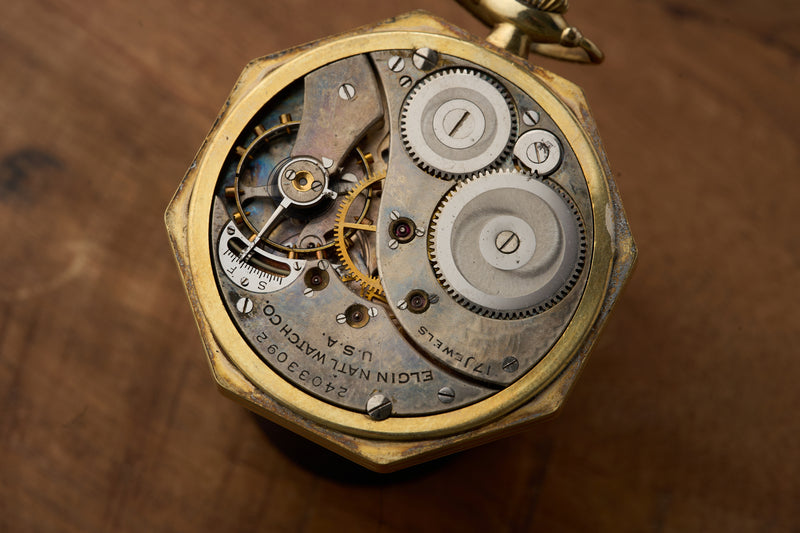
The movement is based on the Roskopf pin-pallet architecture - robust, practical, and widely produced in Switzerland for working-class timekeeping. Here, the movement has been adapted to drive the jump-hour mechanism, an uncommon configuration that adds genuine interest beyond standard Roskopf production. Open the caseback and the jumping cam is clearly visible; the mechanism is exposed, functional, and engaging to watch in action.
The case is nickel, 49.5mm, open-face, with an engine-turned back disc and blank cartouche. Condition is very good - minor surface wear consistent with age, no chips, dents, or damage of note. The crystal is clear. The watch winds, sets, and runs correctly, and the jump mechanism functions as intended.
The dual-aperture display, showing both hours and minutes through windows, is rarer than the more common single jump-hour configuration.