
Ulysse Nardin: The Pursuit of Precision, 1846-1982
The story of Ulysse Nardin, from its founding in Le Locle in 1846 to a century of dominance in observatory chronometry. Told alongside four documented Neuchâtel Observatory split-seconds chronometers. Curated with our friends at Vintage Times, now in The Estate Collection.


The Estate Collection · Journal
Ulysse Nardin
The pursuit of precision, 1846 to 1982
Scroll to begin
In 1846, in the Swiss town of Le Locle, a young watchmaker set himself one problem. Not to make watches that were beautiful, or clever, or cheap. To make watches that would not lie.
Ulysse Nardin had learned the craft through his father, a specialist in minute repeaters, and then under two of the finest precision watchmakers of the day, William Dubois and Louis Richard. From them he took a conviction that would define the house: true accuracy is never a single invention, but the sum of deep knowledge, meticulous adjustment and constant refinement. He dedicated himself to the most demanding discipline in horology, chronometry, and the story that follows is how far he took it.

The Marine Chronometer
Finding your place on an empty seaDuring the nineteenth century, determining a ship's position at sea was one of the greatest scientific challenges of the age. While sailors could establish latitude through astronomical observation, calculating longitude required a precise reference time. The marine chronometer provided that reference. By comparing the time kept aboard a ship with local solar time, navigators could calculate their position across the globe.
The demands placed upon these instruments were extraordinary. A chronometer had to hold its accuracy despite changes in temperature, humidity, movement and the constant motion of the sea. Even a small deviation could place a ship far from its intended destination.
Try it · Why a second mattered
A voyage is only as good as your clock
Here is what a few seconds a day actually meant. Drag the voyage out to sea and watch how far an ordinary watch drifts off course, against a chronometer built for exactly this. At the equator, a single second of time is a quarter of a nautical mile of longitude.
After 24 days, an ordinary watch could put you 30 nautical miles off course. The Ulysse Nardin: 7.
From the archive
A record written down
Recognising the opportunity, Ulysse Nardin devoted his manufacture to marine chronometers of exceptional reliability. In 1862 the firm took a Prize Medal at the International Exhibition in London, and in time supplied instruments to more than fifty navies worldwide, aboard naval vessels, merchant ships and scientific expeditions alike.

Period advertising set out the manufacture's record of Grands Prix, observatory awards and marine chronometers supplied worldwide.

The Observatory Trials
Where the world's watches were judgedThe manufacture's achievements were confirmed, again and again, through the rigorous testing of international observatories. These were not comfortable conditions. Each chronometer was run for weeks in varying positions and temperatures, its rate measured day by day, and only the finest were awarded a bulletin. To dominate that testing across a century was to sit at the very top of what mechanical timekeeping could achieve.
The proof, on paper
The bulletin de marche
The observatory's verdict came as a printed bulletin, recording a chronometer's rate to a fraction of a second. This one was issued at Neuchâtel in November 1953, tested within days of our own 1953 piece, a document of exactly the standard these watches were built to meet.

A period Neuchâtel Observatory Bulletin de Marche, chronometer No. 127298, tested November 1953.

The Split-Seconds
Timing two things at onceThe pursuit of precision was never limited to the oceans. The same expertise was applied to advanced chronographs, including the split-seconds pocket chronographs that count among the most complex timing instruments of their era. A split-seconds, or rattrapante, allows two elapsed times to be measured at once, and it is the reason these four watches exist.
In 1942, a Ulysse Nardin chronograph achieved an average daily deviation of only 0.12 seconds during testing at the Neuchâtel Observatory. One year later the observatory tested movement No. 121026, fitted with a Guillaume integral balance and reading to one-tenth of a second. It placed in the First Prize class, and it is one of the four watches below.
Try it · The Split-Seconds
Two hands, one axis
The words only go so far. Start the mechanism, then split it: one hand stops to mark a time while the other runs on. Split again, and it flies back to catch its partner. This is the exact mechanism inside all four of these watches, and each one still does it today.

The Guillaume Balance
The enemy was temperaturePrecision at this level had a persistent enemy: temperature. Metal swells when it warms and shrinks when it cools, so an ordinary balance wheel changes its rate with the weather, running fast in the cold and slow in the heat. It was the single hardest obstacle to a truly accurate watch. The physicist Charles Édouard Guillaume solved it, winning the 1920 Nobel Prize in Physics for a family of nickel-steel alloys that barely move at all. The compensation balance named after him sits at the heart of every one of these four watches.
Try it · The Guillaume Balance
It grows in the heat. His does not.
Move the temperature and watch the ordinary balance swell and drift off rate, while the Guillaume balance holds almost perfectly still. The same idea won a Nobel Prize, and it is why these watches could be trusted at sea and in the trials alike.

The Collection
Four that surviveEach of these four watches was entered into the Neuchâtel Observatory competition trials, twenty years apart, and each still runs, still splits, and still keeps its word. First the record that documents each one, then the four themselves, where you can move over any dial to look closer.
Every one, documented
Each of the four was entered into the Neuchâtel Observatory trials, and each carries an extract from the observatory's own chronometer database. The serial engraved in the movement is the serial printed on the bulletin. Choose a year, then tap the certificate to see it full screen.

Engraved on the movement, printed on the bulletin.
- Tested
- Neuchâtel Observatory, 1933
- Régleur
- Henri Gerber, Le Locle
- Escapement
- Lever, one-fifth second
- Balance
- Guillaume compensation
- Category
- Chronomètres de Poche, 1re Classe

Steel Split-Seconds Chronometer, First Prize Neuchâtel 1933
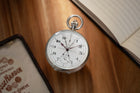
The senior piece. Awarded First Prize in the Chronomètres de Poche 1re Classe, placing 13th of 35, with a Guillaume balance and a steel Breguet overcoil. It arrived in its original box, with the observatory extract, and it still wins.
View this watch
Silver Split-Seconds Observatory Chronometer, Neuchâtel 1937
The only one in silver. A documented entrant in the 1937 trials, cased in sterling silver in Ulysse Nardin's own case, with a Guillaume compensation balance beneath a white enamel dial. The quietest of the four, and the easiest to fall for.
View this watch
Steel Split-Seconds Observatory Chronometer, Neuchâtel 1943
The watch named in the record above. Tested in 1943 and placed in the First Prize class, 18th of 66. A monopusher split-seconds chronograph, where start, stop and reset all run from the crown, on a Guillaume integral balance reading to one-tenth of a second.
View this watch
Steel Split-Seconds Observatory Chronometer, Neuchâtel 1953
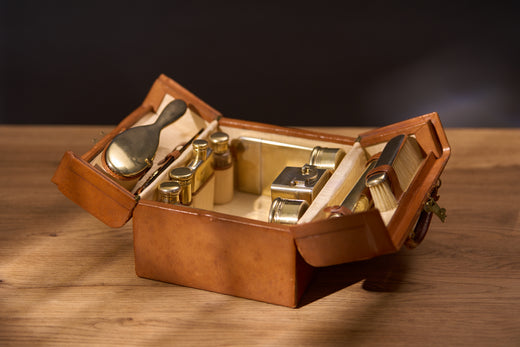
The last and most advanced. Built on the top-grade Caliber 24 CCR, reading to one-tenth of a second, with a Guillaume balance and Nivarox hairspring. Delivered new on 20 April 1954 to a dealer in Genoa as one of only five of its kind, complete with its original red leather travel case.
View this watchFrom a young watchmaker in Le Locle in 1846 to four documented observatory chronometers you can hold today, the thread is unbroken: the relentless pursuit of accuracy. Each is a single, one-of-one piece. If one speaks to you, follow the link, and do ask if you would like to see more.