
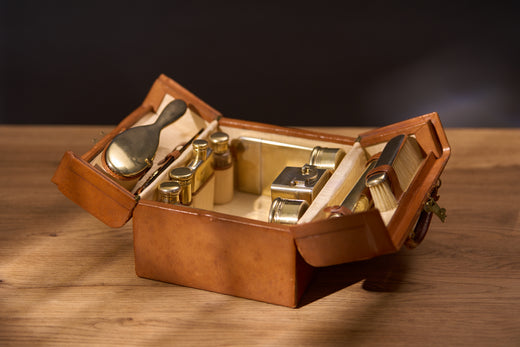

The words that come up in every description on this site, each shown on a piece we have handled. Short by design: enough to read a listing or an auction catalogue without a reference book, and to know which questions to ask.
The case
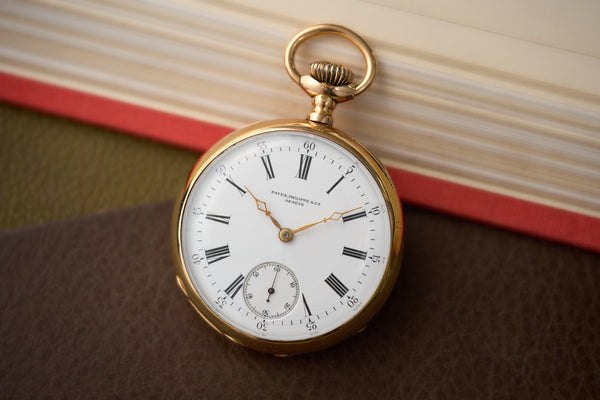
Open face
No cover over the crystal; the dial is read as soon as the watch is out of the pocket. The winding crown sits at 12 and the small seconds at 6. The commonest form from the 1880s on, and the one railway companies required.
This example See the collection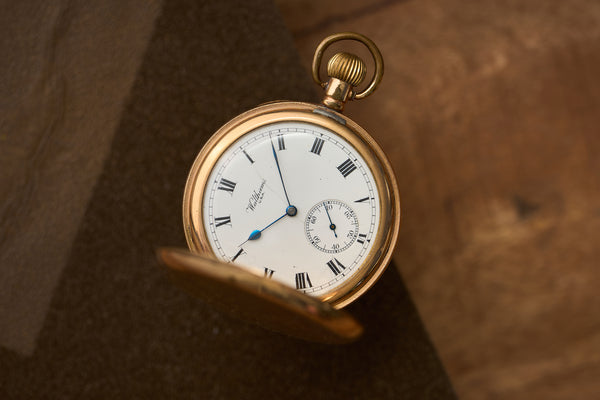
Full hunter
A solid hinged lid over the dial, opened by pressing the crown. Named for the field, where a closed cover protected the glass. The crown is at 3 rather than 12, which is why a hunter movement (savonnette in Swiss usage) is a different layout from an open-face one.
This example See the collection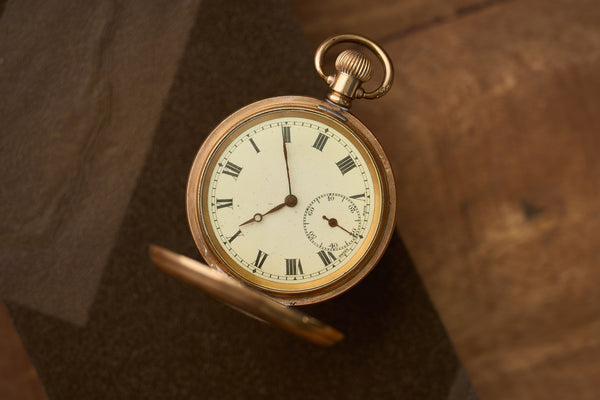
Half hunter
A hunter whose cover has a glazed window in the centre and, usually, the hours engraved or enamelled around it, so the time can be read without opening it. Also called a demi-hunter. Tradition credits the idea to Napoleon, who cut a hole in his cover; the story is unproven but the name Napoleon is still used for the type.
This example See the collection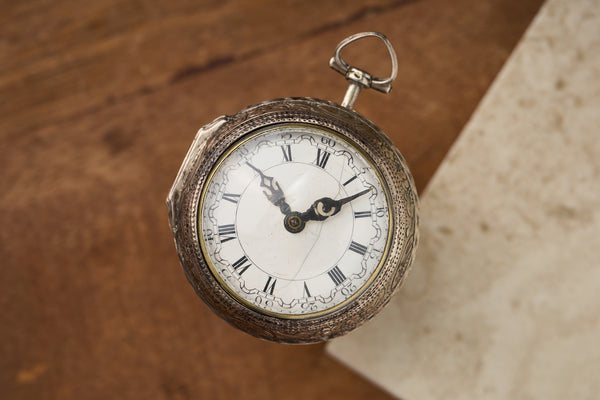
Pair case
The eighteenth-century arrangement: a plain inner case holding the movement, and a separate decorated outer case that the whole thing sits in. The outer case took the wear and could be replaced or upgraded; repoussé silver and shagreen outers were made for the Dutch and Turkish markets. Both cases are usually hallmarked and should carry the same maker's mark.
This example See the collection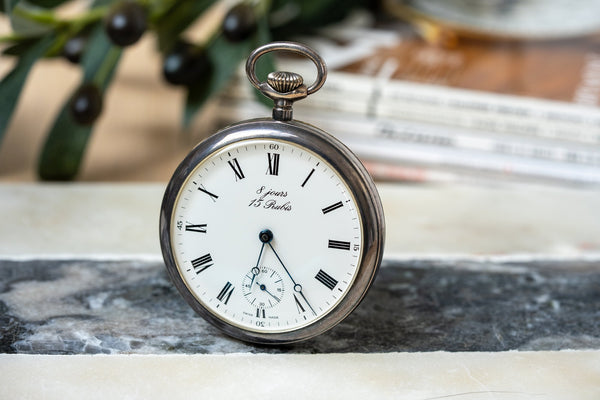
Goliath
An oversized pocket watch, roughly 60 mm and above, made from the 1890s to the 1930s for the desk, the car and the bedside as much as the pocket. Most are eight-day, many have a regulator or calendar dial, and they were often sold in a leather travelling case with a stand.
This example See the collection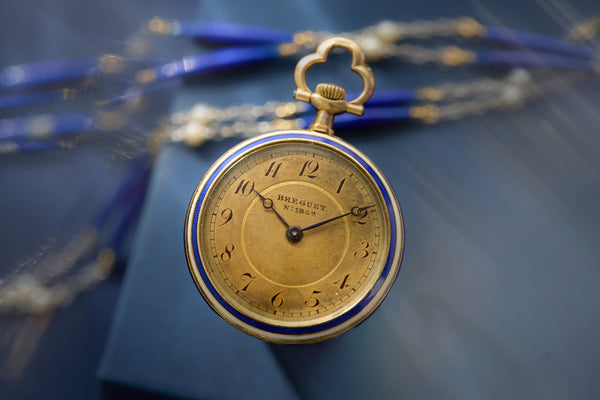
Pendant and fob watch
A small watch, usually under 35 mm, made to hang from a chain, a chatelaine or a brooch rather than sit in a waistcoat. Mostly made for women, often enamelled or gem-set, and the format in which the great houses did some of their finest decorative work.
This example See the collection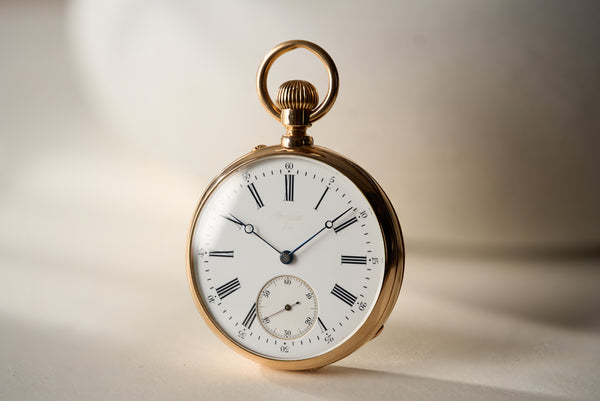
Lépine
A movement layout, and by extension the open-face watches built on it, in which the winding stem and the small seconds sit on the same axis, at 12 and 6. Named for Jean-Antoine Lépine, who in the 1770s did away with the fusee and the full top plate and replaced them with separate bridges, the basis of every flat watch since.
This example See the collectionThe movement
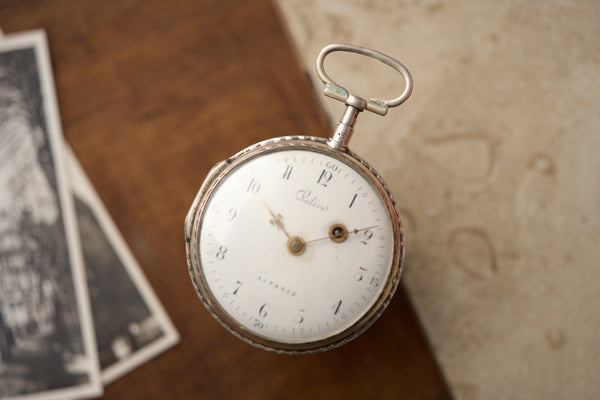
Verge
The oldest escapement, used from the fourteenth century to about 1850. A crown-shaped escape wheel and a vertical staff with two pallets; the balance swings through a wide arc and the watch keeps time to a few minutes a day. Recognisable by the tall, pierced and engraved balance cock over the balance.
This example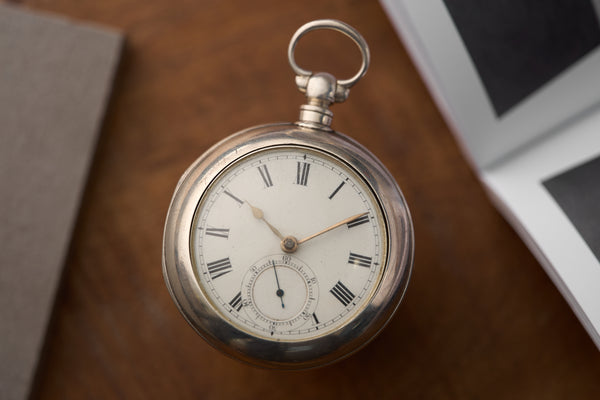
Fusee
A cone-shaped pulley connected to the mainspring barrel by a tiny chain. As the spring runs down, the chain moves to a wider part of the cone and evens out the force, so the watch keeps a steadier rate. English makers kept the fusee long after the Swiss had dropped it, into the 1880s in some lever watches.
This example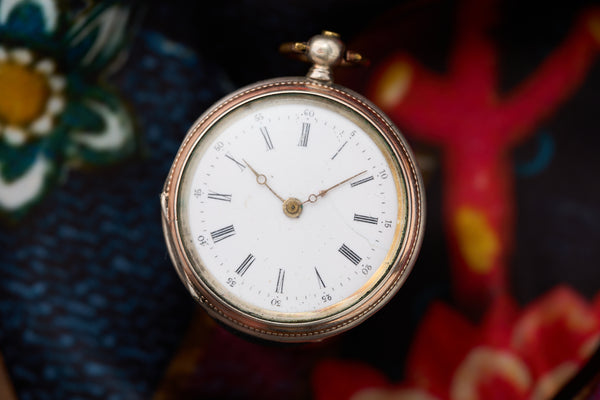
Cylinder
The escapement that replaced the verge in the eighteenth century and became the standard for inexpensive Swiss watches through the nineteenth: a hollow steel cylinder on the balance staff that the escape-wheel teeth pass through. Thinner and cheaper than a lever but less accurate and prone to wear.
This example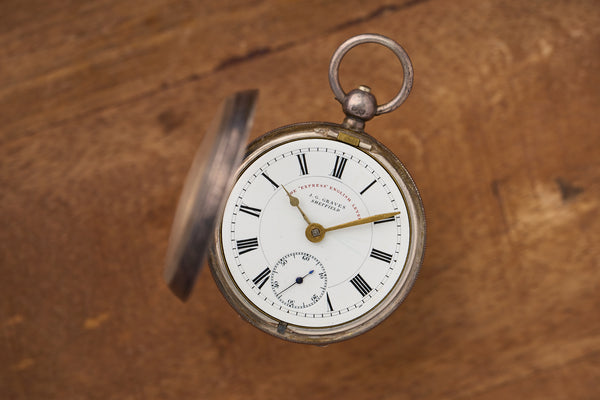
Lever
The escapement in nearly every mechanical watch made since about 1860. A pivoted lever with two jewelled pallets locks and releases the escape wheel and gives the balance a push each swing. English levers of the Victorian period are usually fusee-driven with a right-angle lever; Swiss levers are straight-line and going-barrel.
This example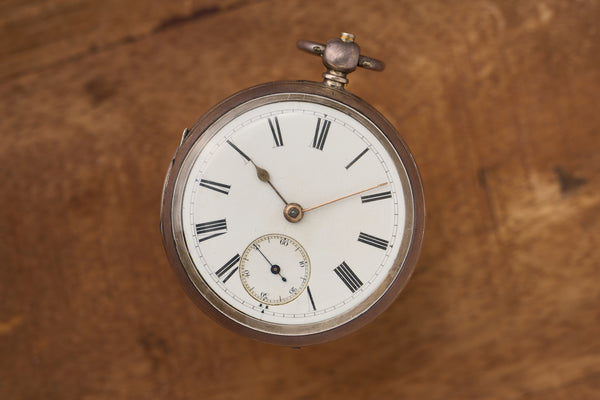
Key wind and keyless
Until the 1870s most watches were wound, and often set, with a separate key through a hole in the back or the dial. Keyless winding through the crown, developed from the 1840s and general by the 1880s, is what makes a watch wind and set from the pendant. A key-wind watch is not older or worse for it, but it does need its key.
This example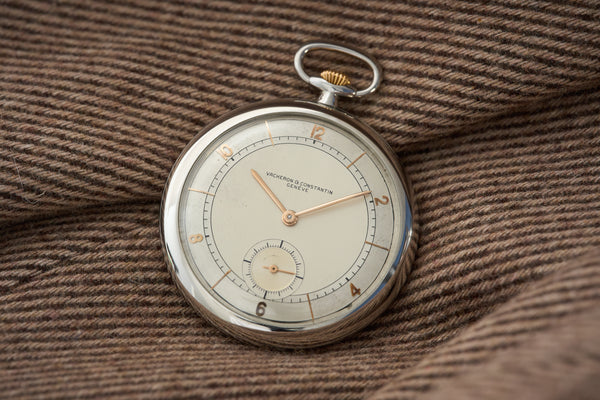
Sub-seconds
A small separate seconds dial, usually at 6 o'clock, driven directly off the fourth wheel. Standard on pocket watches from the mid-nineteenth century; its absence usually means an early, a cheap, or a deliberately plain watch.
This exampleComplications
Repeater
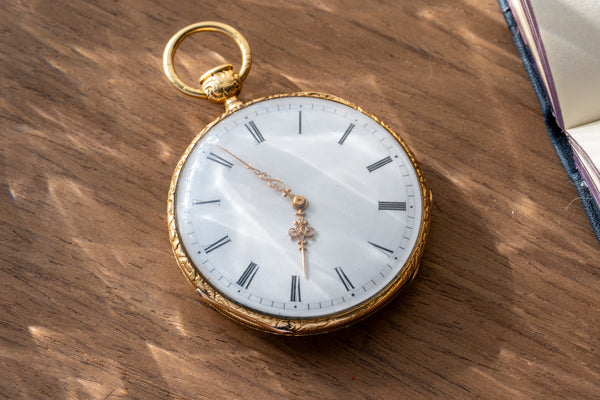
A watch that strikes the time on demand, on gongs inside the case, when a slide or push-piece is operated. A quarter repeater sounds the hours and quarters; a minute repeater adds the minutes. Made so that the time could be told in the dark before electric light. The most demanding complication of the pocket-watch era.
This example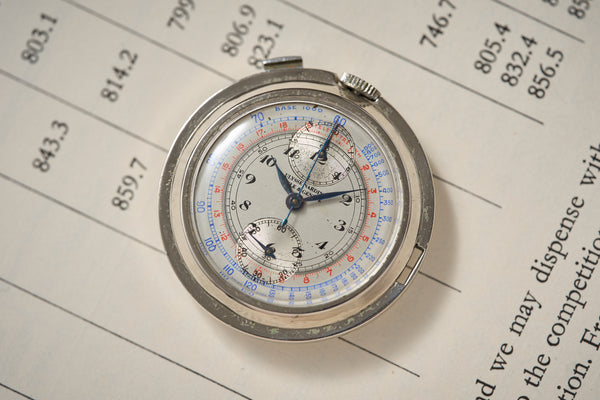
Chronograph
A watch with an independent stopwatch: a centre seconds hand that starts, stops and returns to zero from a pusher, with a small register counting elapsed minutes. In a column-wheel chronograph the functions are switched by a toothed rotating column, the finer and older construction; cam-switched chronographs came later and cheaper.
This example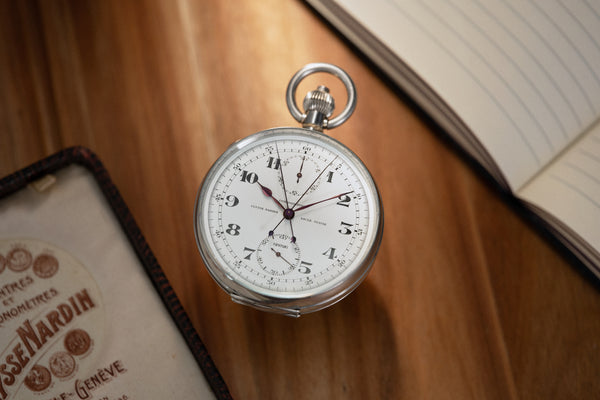
Split-seconds
A chronograph with two centre seconds hands, one on top of the other. A second pusher stops one hand to read an intermediate time while the other runs on; pressed again, it catches up. Rattrapante in French. Used for timing two competitors and, in the observatory trials, the hardest chronograph mechanism to make well.
This example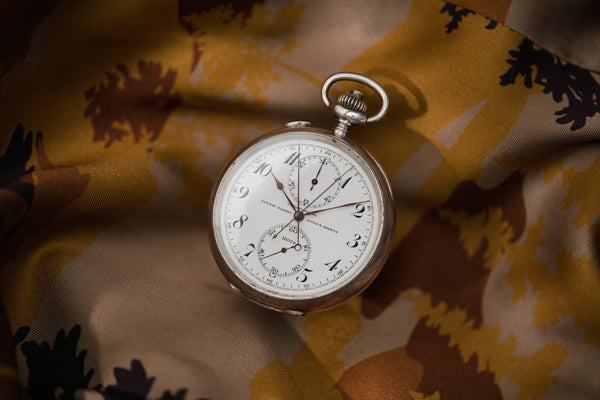
Chronometer
Properly, a watch that has passed a timing test at an observatory (Neuchâtel, Geneva, Kew, Besançon) and holds a certificate saying so, with its rate in six positions and at several temperatures recorded. The word was also used loosely on dials as a mark of quality; the certificate, or the observatory's own records, is what separates the two.
This example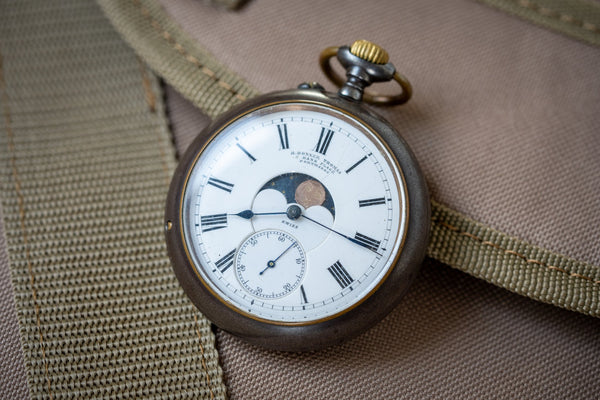
Calendar and moonphase
Subsidiary dials for the day, the date and the month, and a disc that shows the age of the moon through an aperture. A simple calendar needs correcting at the end of short months; a perpetual calendar allows for them, and for leap years, and is a different order of mechanism. Most Swiss calendar pocket watches of the 1880s and 1890s are simple calendars in large cases.
This example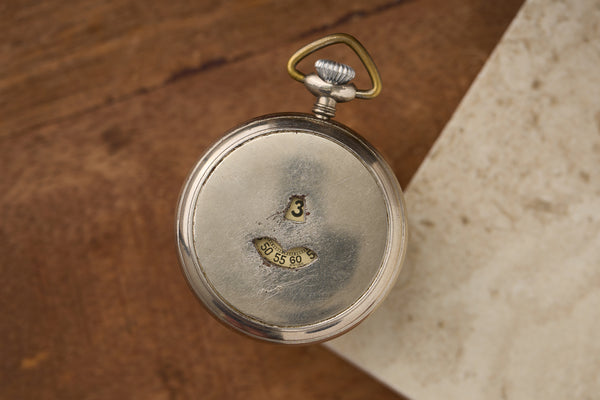
Jump hour
The hour, and sometimes the minute, shown as a numeral in a window instead of by a hand. The hour disc jumps at the top of each hour. Patented in the 1880s, briefly popular around 1900 and again in the Art Deco period.
This example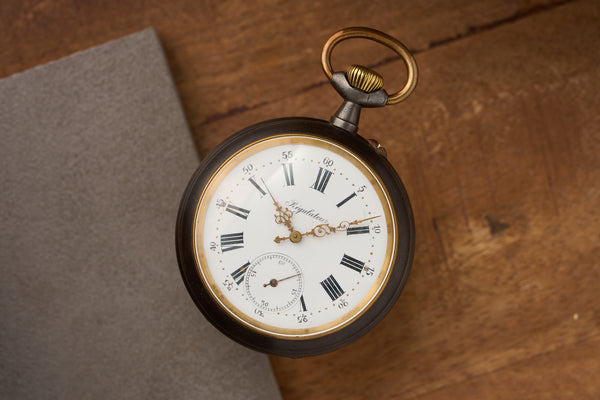
Regulator dial
A dial layout with the hours, minutes and seconds each on their own axis, the large central hand showing minutes only. Copied from the precision regulator clocks watchmakers used to set their work by. Common on Goliath watches and a few observatory pieces.
This example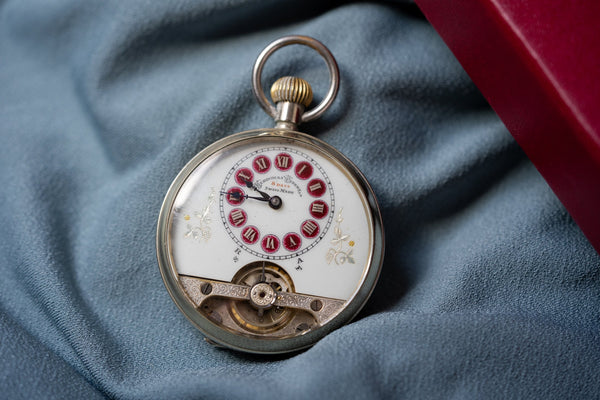
Eight-day
A watch that runs for a week on one winding, on a very large mainspring. The Hebdomas type, made from 1888, put the balance wheel on show through an aperture in the dial. Most eight-day watches are large, and many were made as travelling or car clocks.
This example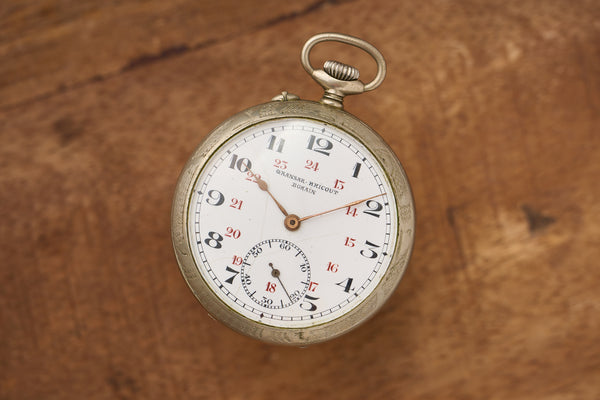
24-hour dial
A dial with a second ring of numerals from 13 to 24 inside the usual twelve, often in red. Made for railway workers after the continental railways adopted 24-hour time in the 1890s, and for the military. The movement is an ordinary one; the difference is on the dial.
This exampleDecoration and materials
Guilloché
Engine turning: a fine repeating pattern cut into metal on a rose-engine or straight-line lathe. Used on case backs, dials and, under translucent enamel, as the ground that gives the enamel its depth. Hand-guided machine work, and by the twentieth century a specialist trade of its own.
This exampleEnamel
Powdered glass fused to metal in a kiln. White enamel dials are the standard dial of the pocket-watch era and are checked for hairlines and chips; coloured translucent enamel over guilloché, and painted enamel scenes, are the decorative work of the finest houses and the first thing to inspect for restoration.
This example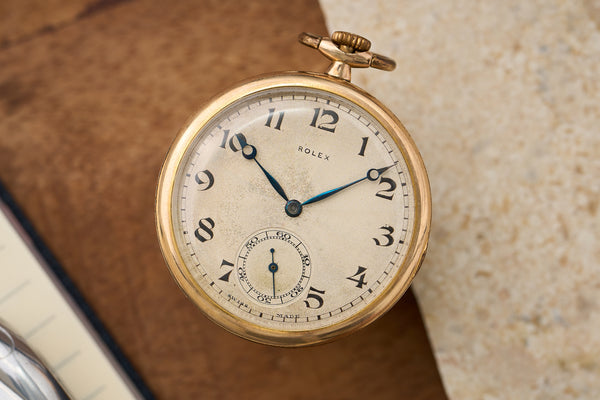
Gold-filled and rolled gold
A thick layer of gold bonded to a base-metal core, far heavier than plating and guaranteed by the case maker for ten, twenty or twenty-five years of wear. Gold-filled is the American term, rolled gold the British. Marked as such inside the case, never with a gold hallmark.
This example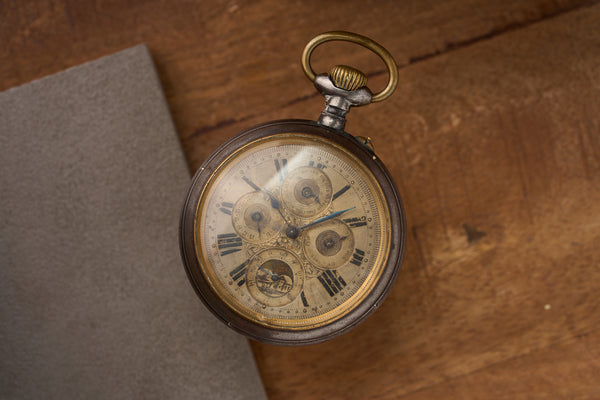
Gunmetal
Blued or blackened steel, oxidised for a dark finish, used for inexpensive and sporting cases from the 1880s to the 1920s. Light, hard-wearing and unhallmarked. The finish wears to grey at the edges with age; original dark gunmetal in good condition is uncommon.
This example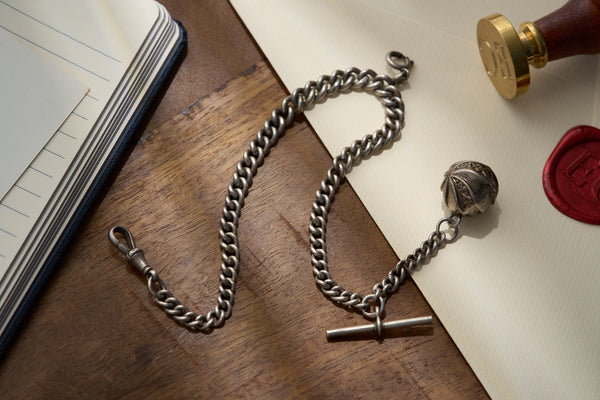
Albert chain
The watch chain worn across the waistcoat, named after Prince Albert. A single Albert has one chain from the watch to a T-bar in a buttonhole; a double Albert has two, with a fob or medal on the second. Silver examples from the 1880s to the 1920s are hallmarked on the T-bar and often on every link.
This example See the collection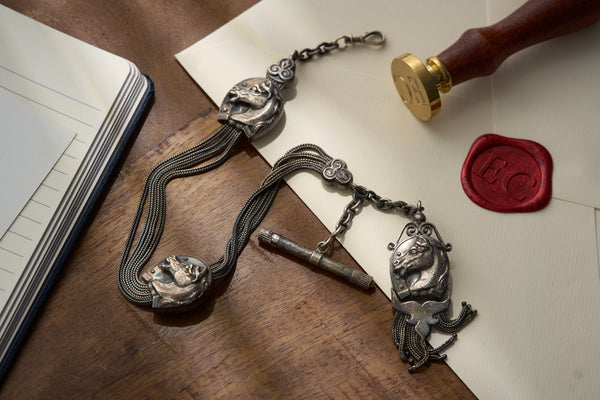
Fob chain
A short chain that hangs from the watch pocket with a seal, a key or an ornament at the end, worn when the watch itself is out of sight. Earlier than the Albert and, by the late nineteenth century, mostly a lady's or a country style.
This example See the collection